Table of Contents
- Your Opener Doesn’t Lift Your Door—Your Springs Do
- Why Your Springs Are Slowly Failing (Even If You Can’t See It)
- Why Ignoring a Heavy Door Will Cost You Hundreds in Opener Repairs
- A Slamming Garage Door is a 200-Pound Safety Hazard
- Not All Springs Are Created Equal: Understanding Your System
- The Real Cost of Ignoring Your Heavy Garage Door
- Final Thoughts
If your garage door has started feeling like it weighs a ton when you try to lift it manually—or worse, if it slams to the ground like a guillotine when closing—you’re not alone. Most homeowners immediately blame the garage door opener motor. But here’s the truth that could save you hundreds of dollars and prevent a serious injury: your opener isn’t the problem. Your springs are. Every day, thousands of Americans unknowingly operate garage doors with dangerously compromised spring systems. According to the U.S. Consumer Product Safety Commission’s National Electronic Injury Surveillance System (NEISS), garage doors are responsible for tens of thousands of emergency room visits annually, with crush injuries and spring-related trauma being among the most severe. A door that feels heavy isn’t just inconvenient—it’s a mechanical failure in progress that will burn out your expensive opener motor, damage your door panels, and put anyone in its path at serious risk. In this article, we’ll break down the hidden physics of garage door counterbalance systems, explain why spring tension loss is the real culprit behind your “heavy door” problem, and show you why professional re-balancing isn’t optional—it’s essential for safety and your wallet.
Your Opener Doesn’t Lift Your Door—Your Springs Do
Most homeowners believe the motorized opener is responsible for lifting the massive weight of their garage door. This fundamental misunderstanding can cost you thousands of dollars in unnecessary repairs and replacement parts. The mechanical reality is far different: the springs do virtually all the heavy lifting, and the motor just guides the door.
The Weight Reality
A standard residential double-car garage door weighs between 150 and 400 pounds, depending on whether it’s made of steel, solid wood, or contains decorative glass panels. That’s the equivalent of two to four full-grown adults hanging from your garage ceiling. Yet most of us operate these doors multiple times daily without giving a second thought to the engineering marvel that makes this possible.
The Counterbalance Principle
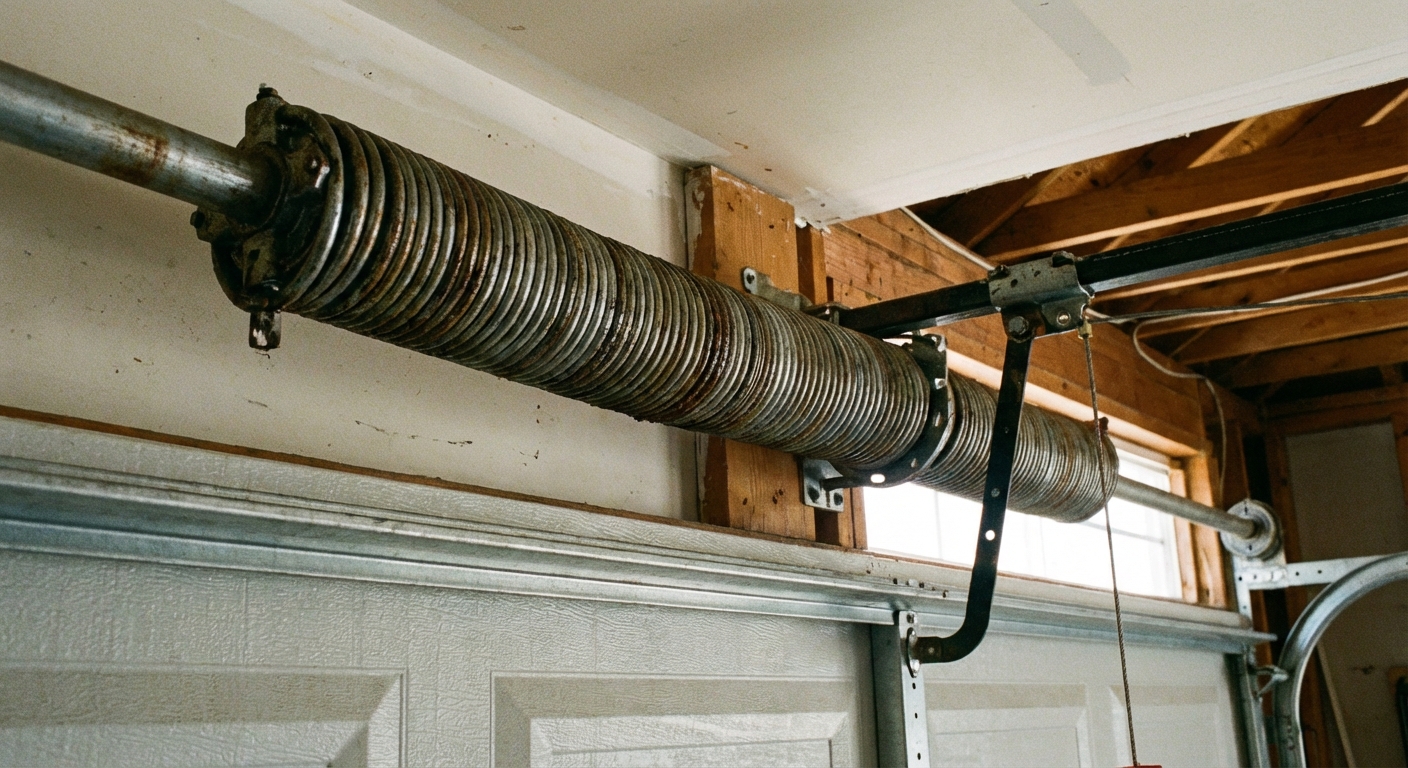
Garage doors rely on high-tension steel springs—either torsion or extension types—that store kinetic energy. As the door closes, the springs stretch or twist, storing the door’s gravitational potential energy. When the door opens, this stored energy is released, effectively offsetting the door’s dead weight. It’s essentially a sophisticated pulley system that converts weight into manageable, balanced motion. Think of it like a seesaw: when properly balanced, even a small child can lift an adult on the opposite end. Your garage door works on the same principle. The springs create a counterbalance so precise that a properly functioning door should weigh only 10-15 pounds of effective lifting weight—light enough for anyone to lift with one hand.
What the Opener Actually Does
This is where the common misconception becomes expensive. Your garage door opener motor is designed to move a properly balanced door that weighs only 10-15 pounds of effective lifting weight. The motor acts as a regulator and locking mechanism, not a primary lifting force. It provides the gentle push needed to overcome friction and inertia, then locks the door in place when fully open or closed. When springs lose tension, homeowners assume their opener is failing and rush to replace a $500 motor when the real problem is a $150 spring adjustment. It’s like replacing your car’s engine when you just needed new tires.
The Balanced Door Test
Here’s a simple diagnostic test you can perform right now: disconnect your opener (pull the red emergency release cord) and manually lift your garage door halfway. A properly balanced door should:
- Lift easily with minimal force
- Stay in place when released at the halfway point
- Lower smoothly without slamming
If your door drops immediately, requires significant force to lift, or feels like you’re doing a deadlift at the gym, your springs have lost critical tension. This isn’t a “wait and see” situation—it’s a mechanical failure that demands immediate attention from professionals like Smart Doors LLC.
Why Your Springs Are Slowly Failing (Even If You Can’t See It)
Understanding why springs fail helps explain why this problem is inevitable, not accidental. It’s not a question of if your springs will lose tension—it’s when.
Material Science and Metal Fatigue
Garage door springs are manufactured from high-carbon, oil-tempered steel wire. This material is chosen for its exceptional strength-to-weight ratio and ability to store massive amounts of elastic energy in a compact coil. However, even this robust material has limitations. Every time you open and close your garage door, the steel undergoes what engineers call cyclic fatigue—microscopic structural degradation that occurs with every bend, twist, and flex. At the molecular level, tiny fissures develop in the steel’s crystalline structure. Over thousands of cycles, these fissures propagate, weakening the metal’s ability to return to its original shape.
Hooke’s Law and Spring Degradation
According to Hooke’s Law, the force needed to compress or extend a spring scales linearly with distance—double the compression, double the force required. In a perfect world with perfect materials, springs would maintain this relationship indefinitely. But we don’t live in a perfect world. After thousands of open-close cycles, those microscopic fissures decrease the spring’s stiffness (its “spring constant”). The result? Progressive loss of torque. The spring can’t store as much energy, which means it can’t offset as much of the door’s weight. What started as a 200-pound door with 10 pounds of lifting weight gradually becomes a 200-pound door with 50, 75, or even 100+ pounds of lifting weight.
Cycle Life Expectations
How long should you expect your springs to last? Industry data provides clear benchmarks: Torsion Springs: These horizontal springs mounted above your door opening typically last 15,000 to 30,000 cycles, translating to approximately 7-15 years with average use (opening and closing 3-4 times daily). Extension Springs: These springs running parallel to your horizontal tracks have a shorter lifespan of 10,000 to 15,000 cycles, lasting approximately 5-10 years under normal conditions. One cycle equals one complete open-and-close sequence. If you’re opening your garage door four times daily, that’s 1,460 cycles per year. A 15,000-cycle torsion spring would theoretically last about 10 years. However, extreme temperatures, humidity, lack of lubrication, and manufacturing variations can significantly reduce this timeline.
The Two Warning Signs
Your garage door will tell you when springs are failing. Listen carefully:
Both symptoms indicate your counterbalance system is in critical failure. Continuing to operate the door in this condition isn’t just inconvenient—it’s dangerous and destructive.
Why Ignoring a Heavy Door Will Cost You Hundreds in Opener Repairs
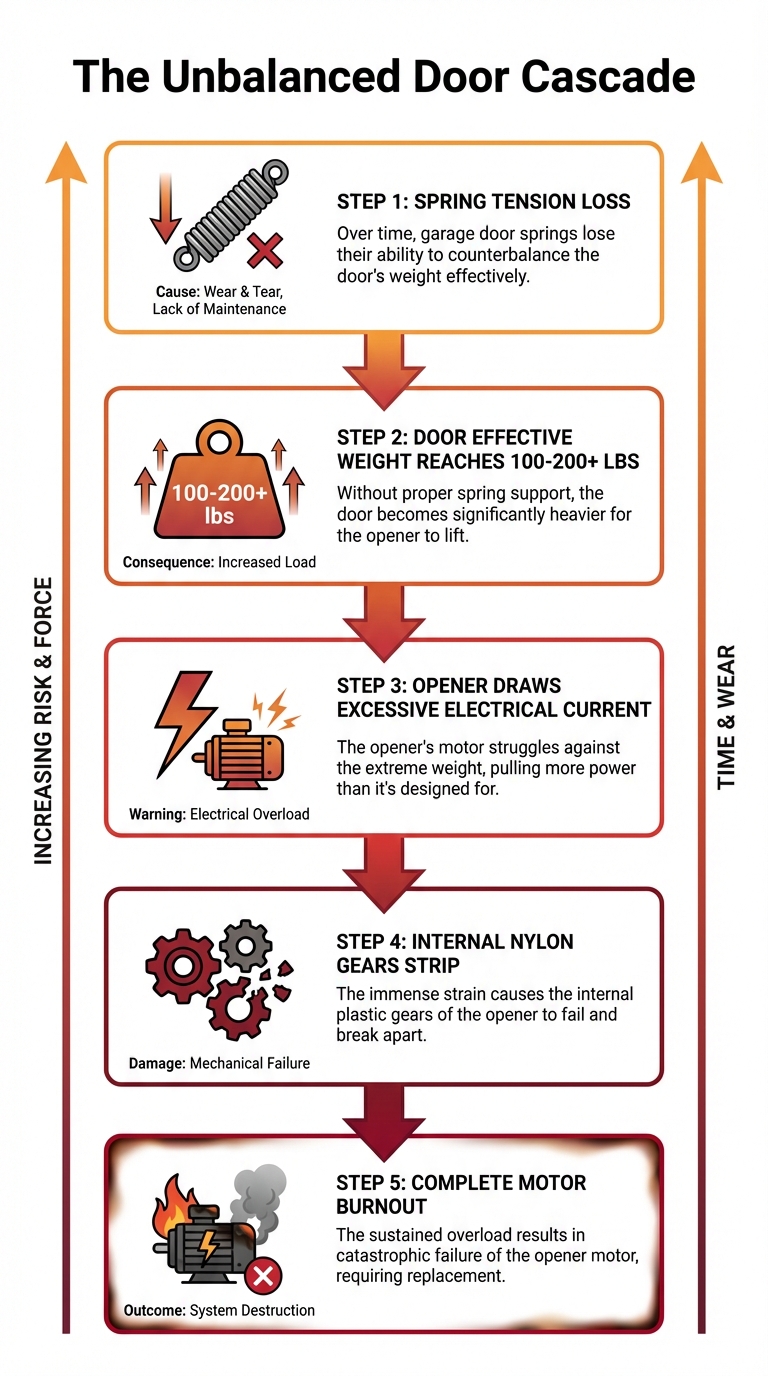
When springs lose tension, every subsequent door operation becomes an endurance test for your garage door opener—a test it was never designed to pass.
The Design Limitation
Residential garage door openers are precision-engineered for one specific task: moving a balanced door requiring only 10-15 pounds of force. The motor, gearing system, and electrical components are calibrated around this parameter. When springs fail and the door suddenly weighs 100-200+ pounds of lifting weight, you’ve fundamentally changed the mechanical equation. It’s the equivalent of asking a bicycle to tow a car. Sure, the motor will try—but the strain will destroy every component in the system.
Three Stages of Opener Burnout
The failure cascade follows a predictable pattern: Stage 1: Excessive Amperage Draw The motor draws dangerously high electrical current to compensate for the unbalanced weight. You might notice the lights dimming slightly when the door operates, or hear the motor straining with a deeper, labored hum. Modern openers have built-in thermal protection sensors designed to shut down the motor before catastrophic damage occurs—but this safety feature isn’t foolproof, and it doesn’t address the underlying problem. Stage 2: Stripped Gears Most residential openers use nylon or plastic composite gears specifically chosen to minimize noise during operation. These materials are perfectly adequate for moving a 10-15 pound balanced door. They are catastrophically inadequate for lifting 200 pounds. The extreme load causes immediate shearing of gear teeth. You’ll hear a grinding sound, or the motor will run without the door moving at all. Once gears strip, the entire drive assembly requires replacement—often costing as much as a new opener unit. Stage 3: Capacitor and Motor Failure If the system survives long enough to avoid stripped gears, sustained electrical and mechanical strain will eventually burn out the start capacitor (which provides the initial power surge to get the motor spinning) or the AC/DC motor itself. When this happens, the opener is completely dead. No lights, no movement, no response to the remote. At this point, you’re looking at a $500+ replacement bill for an opener that might have been only three to five years old—a unit that should have lasted 10-15 years with proper maintenance.
The Lifespan Impact
Industry research clearly demonstrates the correlation between spring tension and opener longevity. Operating an unbalanced door can reduce garage door opener lifespan by up to 75%. A simple $100 spring tune-up becomes a $500+ opener replacement, plus the additional cost of potential door panel damage from years of slamming impacts.
Real-World Evidence
A comprehensive property management study examined maintenance records across a 200-unit townhome complex over five years. The results were striking: the complex reported a 40% failure rate of garage door opener motors within just three years—well below the expected 10-15 year lifespan. Professional inspection revealed the root cause: 85% of the doors had never received spring re-balancing since installation. The loss of spring tension added an average of 65 pounds of lifting weight per door. After implementing a bi-annual professional spring tuning protocol, opener motor failures dropped by 90% over the next two years. The lesson is clear: maintaining proper spring tension isn’t optional maintenance—it’s the difference between a door system lasting 15 years versus 3 years.
A Slamming Garage Door is a 200-Pound Safety Hazard
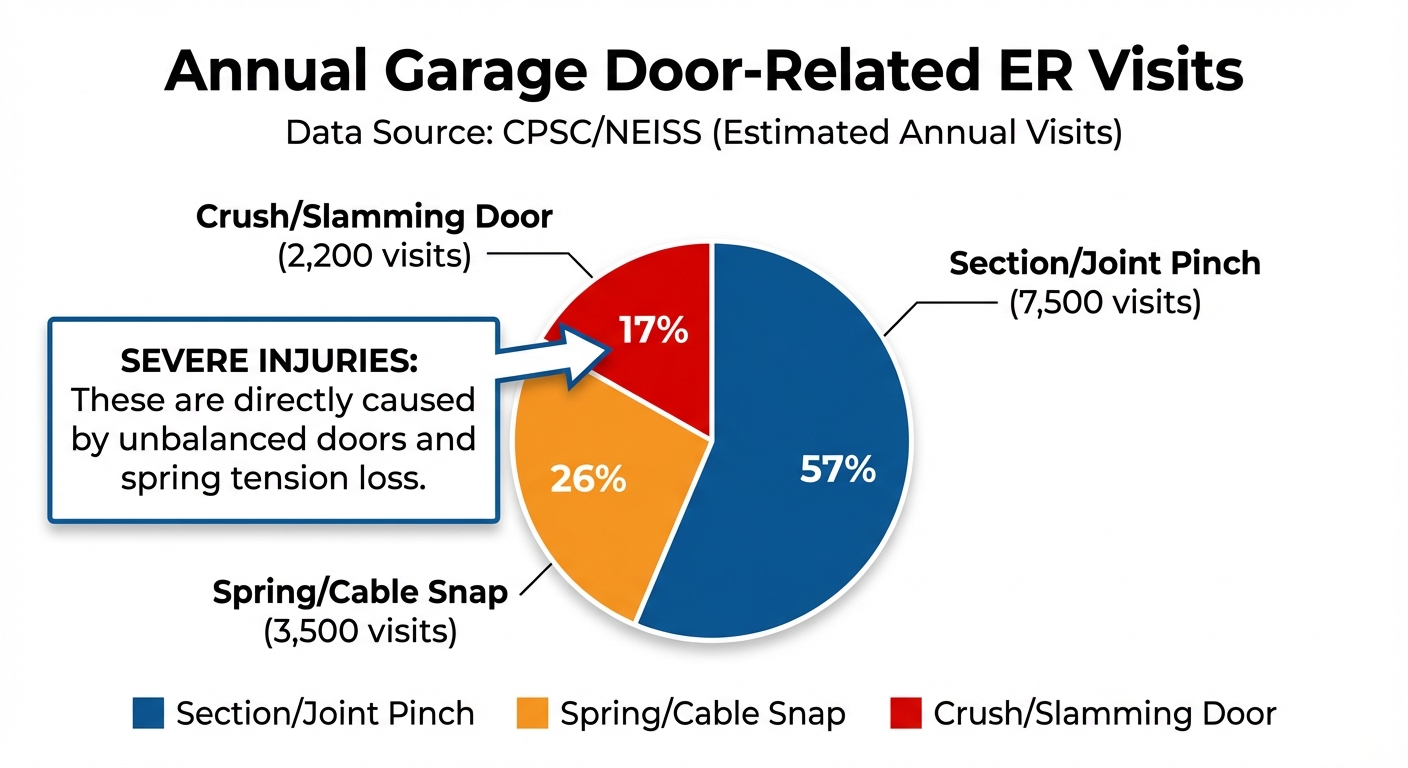
Beyond the financial cost of system failure, an unbalanced garage door poses severe crush and injury risks that put your family, pets, and guests in genuine danger every time the door operates.
National Injury Statistics
The data is sobering. According to the U.S. Consumer Product Safety Commission’s National Electronic Injury Surveillance System (NEISS), garage doors are responsible for approximately 13,200 emergency room visits annually in the United States. These aren’t minor bruises and scrapes—they’re serious injuries requiring immediate medical intervention. The injury categories break down into three primary mechanisms:
- Section/Joint Pinch Injuries: Roughly 7,500 annual ER visits result from fingers, hands, or limbs getting caught between door sections or in the track joints. These injuries range from severe lacerations to complete digit amputations. While modern doors with pinch-resistant designs have reduced these incidents, older door systems remain particularly hazardous.
- Crush Injuries from Slamming Doors: Approximately 2,200 annual ER visits stem directly from the loss of spring tension creating unbalanced doors. When a heavy door slams shut, it delivers blunt force trauma, fractures, and crushing injuries. Children and pets are particularly vulnerable because they’re often in the garage’s “danger zone” without understanding the risk.
- Spring/Cable Snap Injuries: About 3,500 annual ER visits result from springs or cables breaking during operation—or during DIY repair attempts. These injuries include severe facial trauma, eye injuries requiring emergency surgery, and deep lacerations from the high-velocity steel components.
The Free-Fall Danger
Here’s what makes an unbalanced door particularly treacherous: modern garage door openers have photoelectric safety sensors (those small units mounted near the floor on either side of the door opening). These sensors detect obstructions and command the opener motor to stop and reverse. But here’s the critical limitation most homeowners don’t understand: those sensors only stop the motor—they cannot physically stop a 200+ pound door in mechanical free-fall. When a severely unbalanced door loses spring tension, it’s not being lowered by the motor—it’s falling under its own weight while the motor desperately tries to slow the descent. If something (or someone) triggers the safety sensor, the motor stops, but momentum and gravity don’t. The door continues its downward trajectory, crushing anything in its path. This is why unbalanced doors are responsible for some of the most severe garage door injuries. The safety systems we rely on simply can’t overcome basic physics.
The DIY Danger
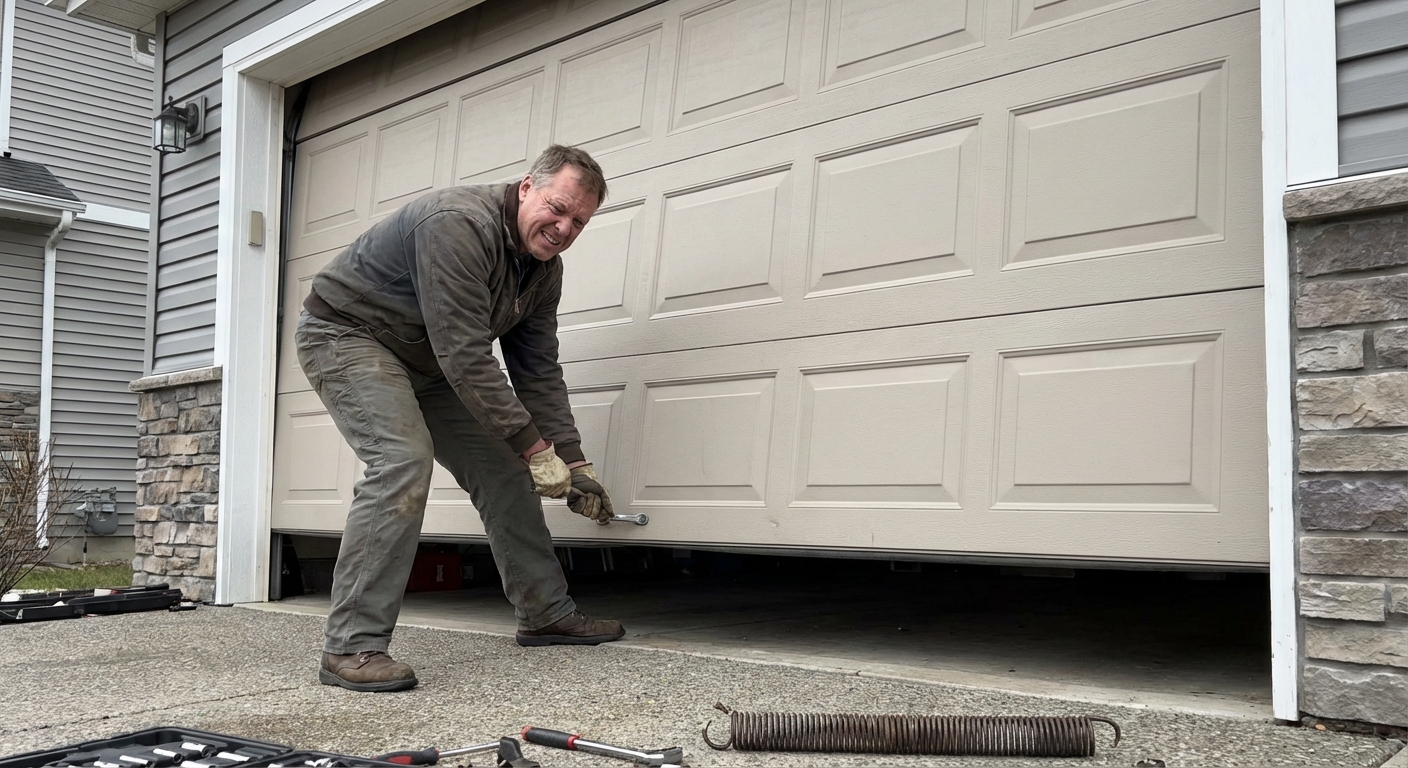
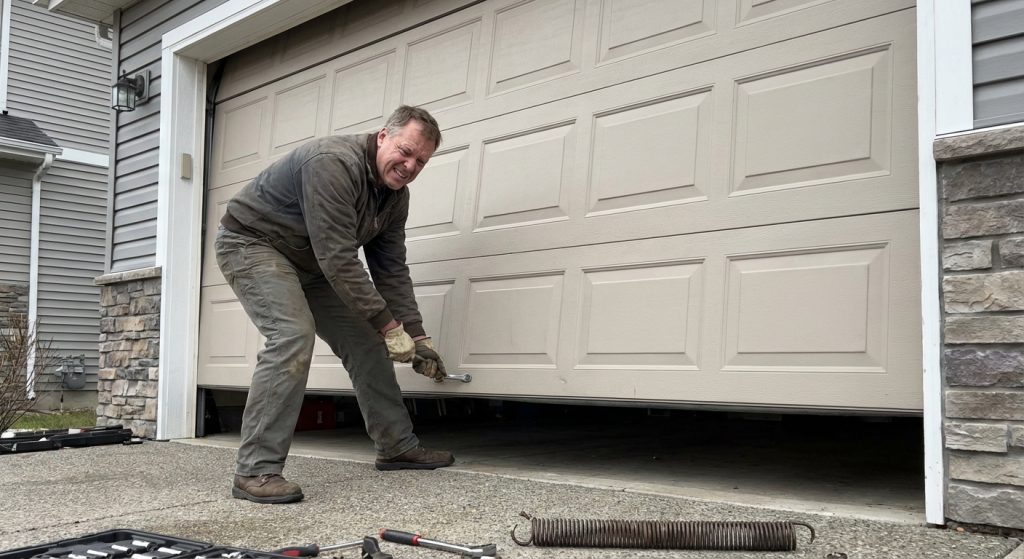
Every year, well-intentioned homeowners attempt to adjust their own garage door springs to save money. These attempts frequently end in the emergency room.
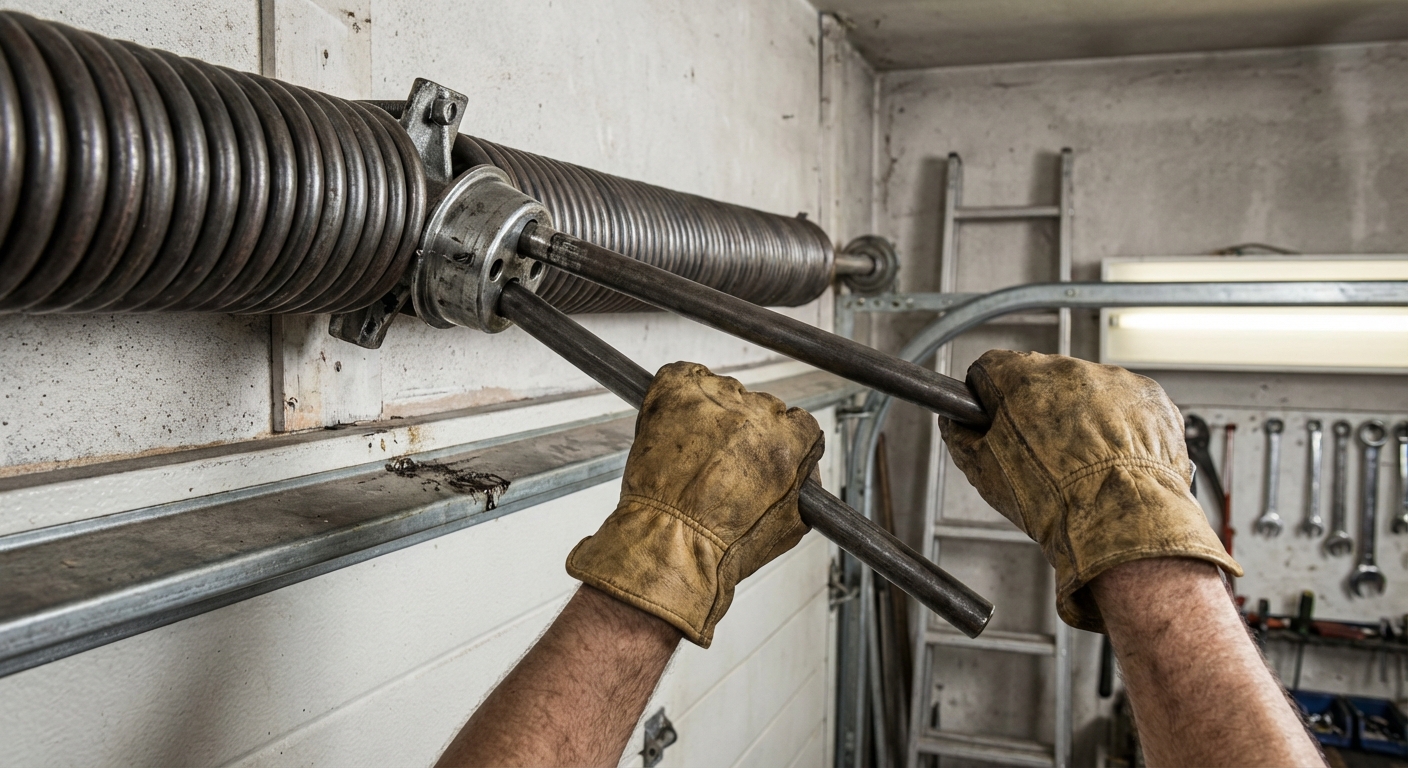
Torsion springs store tremendous amounts of kinetic energy—enough to lift hundreds of pounds repeatedly. That energy, when released uncontrolled, becomes a weapon. Professional technicians use specialized steel winding bars specifically designed to handle this torque safely. Improvised tools will fail catastrophically. The message is unequivocal: never attempt to adjust garage door springs yourself. This isn’t a task for weekend warriors—it requires professional training, specialized tools, and comprehensive understanding of the mechanical forces involved.
Not All Springs Are Created Equal: Understanding Your System
Understanding whether your garage door uses torsion or extension springs helps you diagnose problems more accurately and set realistic expectations for lifespan and safety.
Torsion Springs: The Modern Standard
| Characteristic | Details |
|---|---|
| Location | Mounted horizontally above the door opening on a metal shaft (torsion tube) |
| How They Work | Twist and untwist to store and release energy through the torsion tube and cable drums |
| Cycle Life | 15,000 to 30,000 cycles (7-15 years of service life) |
| Failure Profile | Gradual tension loss with progressive symptoms over time |
| Safety | Remains contained on torsion tube when broken—no projectile risk |
Professional Adjustment Required: Adjusting torsion springs requires specialized steel winding bars (typically 18-24 inches long) and precise knowledge of winding cone mechanics. This is absolutely not a DIY project.
Extension Springs: The Traditional System
| Characteristic | Details |
|---|---|
| Location | Mounted on either side of the door, parallel to horizontal tracks |
| How They Work | Stretch and contract to store and release energy through attached cables |
| Cycle Life | 10,000 to 15,000 cycles (5-10 years of service life) |
| Failure Profile | More sudden failure with visible coil separation before breaking |
| Safety | Significant projectile hazard—requires safety containment cables |
Professional Adjustment Required: Like torsion springs, extension spring adjustment requires professional expertise and specialized tools. The high tension and projectile risk make DIY attempts exceptionally dangerous.
The Bottom Line
Whether your door uses torsion or extension springs, both systems will inevitably lose tension over time. The physics are inescapable. The International Door Association strongly advises against DIY adjustments for either system due to the extreme kinetic energy stored in the coils and the specialized tools required for safe adjustment. When you notice symptoms of spring failure—heavy lifting, slamming drops, visible spring damage—contact Smart Doors LLC immediately. This isn’t an area where “close enough” is acceptable. Spring tension must be calibrated precisely to balance the door’s weight, and that calibration requires professional expertise.
The Real Cost of Ignoring Your Heavy Garage Door
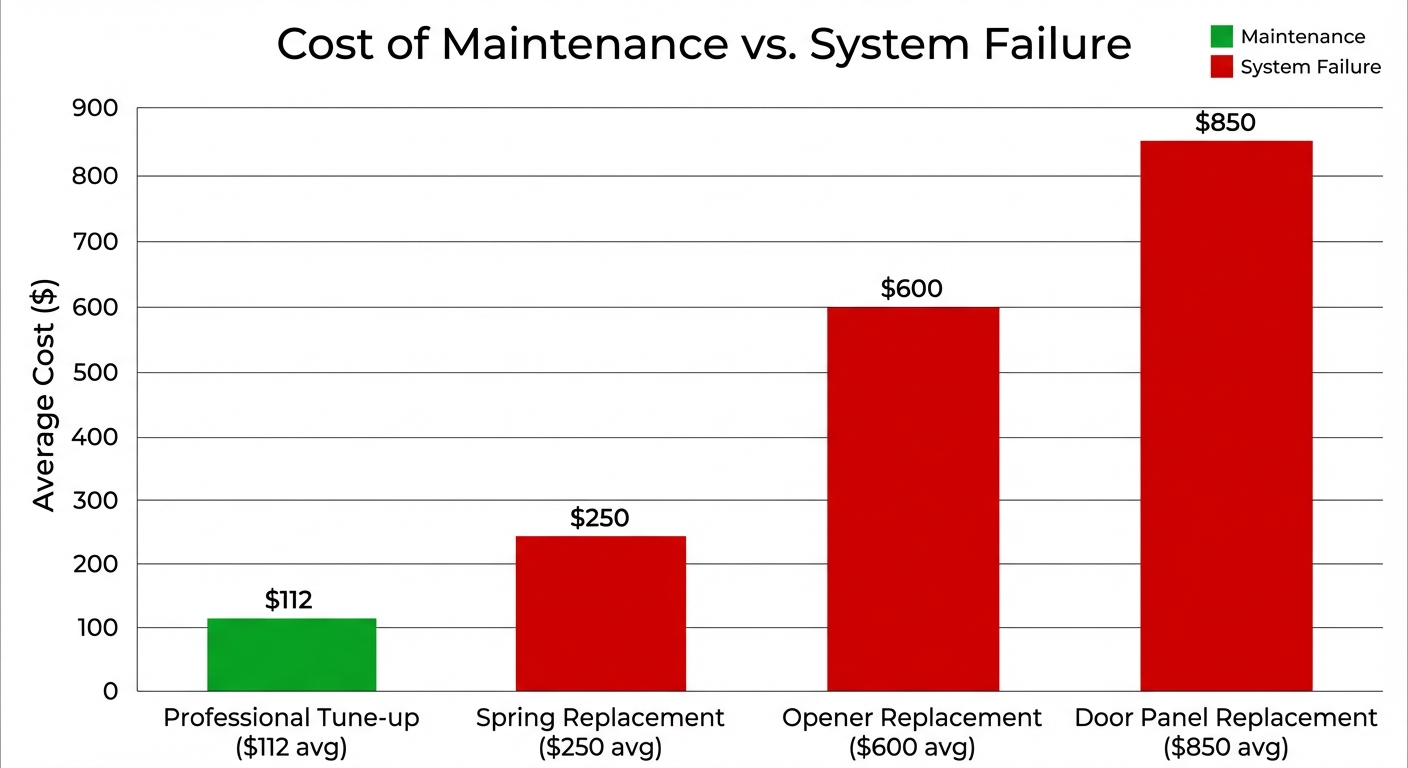
From a purely economic standpoint, investing in professional spring re-balancing is dramatically cheaper than dealing with the cascading system failures that result from neglect.
The Cost Comparison
Let’s examine the real numbers:
| Service | Cost Range | What’s Included |
|---|---|---|
| Professional Spring Re-balancing/Tune-up | $75-$150 | Spring tension measurement, hardware lubrication, safety sensor testing, cable inspection, opener force adjustment |
| Spring Replacement | $150-$350 | New spring installation (cost varies by type and door weight) |
| Garage Door Opener Replacement | $500-$800+ | New opener unit ($300-$600+) plus installation labor ($200+) |
| Door Panel Replacement | $500-$1,200+ | Individual panel replacement; full door replacement if multiple panels damaged ($1,500-$3,000+) |
The ROI Argument
The math is straightforward: a $100 professional tune-up prevents $500+ in opener replacement costs and avoids $500-$1,200+ in door panel damage. That’s a 5-to-1 to 17-to-1 return on investment—and that doesn’t even account for the prevented injury risk. Consider the total cost of neglect over a 10-year period:
With Regular Maintenance
$100 tune-up every 18 months
$650 total
Over 10 years
Without Maintenance
$600 opener + $350 spring + $800 panel repair
$1,750 total
Over 10 years
You’re looking at nearly triple the expense by skipping routine maintenance—plus the inconvenience of multiple emergency repair calls and the constant safety risk.
Preventative Maintenance Schedule
Think of it like changing your car’s oil. You don’t wait until the engine seizes—you perform routine maintenance on a schedule. Your garage door deserves the same preventative approach.
What Professional Service Includes
When you hire qualified professionals like Smart Doors LLC, a comprehensive service call includes far more than just spring adjustment:
- Spring Tension Measurement: Precise calibration using professional tools to ensure the door is perfectly balanced
- Hardware Lubrication: Application of proper lubricants to rollers, hinges, springs, and bearings to reduce friction and extend component life
- Safety Sensor Testing: Verification that photoelectric sensors are properly aligned and functioning to prevent accidents
- Cable and Pulley Inspection: Examination of lift cables for fraying, pulley wheels for wear, and proper cable tracking
- Opener Force Adjustment: Calibration of the opener’s up-force and down-force settings to match the door’s current spring tension, reducing motor strain
This comprehensive approach addresses the entire door system, not just the immediate symptom. It’s preventative care that extends the lifespan of every component.
Final Thoughts
Your garage door’s springs are the unsung heroes of your home’s most-used entry point—until they fail. When a door starts feeling heavy or slamming dangerously fast, it’s not a minor inconvenience that can wait until next month or next year. It’s a mechanical failure in progress that will destroy your opener motor, damage your door, and put your family at serious risk of crush injuries. The physics are simple and unforgiving: without properly tensioned springs, your 200+ pound door becomes a free-falling hazard that your opener was never designed to handle. The motor will burn out trying. The door panels will crack from repeated impacts. And anyone—particularly children or pets—in the door’s path faces genuine danger. The financial math is equally straightforward: a $100 professional spring tune-up prevents $500-$1,700+ in cascading system failures. It’s not an expense—it’s an investment in safety, longevity, and peace of mind. Don’t wait for the slam. Don’t risk the injury. And definitely don’t attempt a DIY fix on a system storing enough kinetic energy to cause severe trauma. The springs in your garage door exert hundreds of pounds of force, and releasing that energy without proper tools and training can result in life-altering injuries. If your garage door feels heavy when you lift it manually, drops faster than normal, or makes unusual noises during operation, contact Smart Doors LLC today for a professional spring inspection and re-balancing. The certified technicians have the specialized tools, training, and expertise to safely diagnose and correct spring tension issues before they escalate into expensive failures or dangerous accidents.
Ready to Protect Your Investment and Family?
Don’t wait until your ticking time bomb goes off. Schedule your professional garage door inspection today.
Call 360-442-3092 or visit our contact page to speak with a certified technician.
Your opener—and your family’s safety—depend on it. Your garage door deserves the same preventative care you give your car, your HVAC system, and your roof. Make spring maintenance a priority, and you’ll enjoy safe, reliable door operation for years to come.
References:
- InterNACHI (International Association of Certified Home Inspectors). (2023). Garage Doors and Openers Inspection Guidelines. Retrieved from https://www.nachi.org/garage-doors-openers.htm
- DASMA (Door & Access Systems Manufacturers Association). (2022). Technical Data Sheet #161: Garage Door Counterbalance Systems. Retrieved from https://www.dasma.com/technical-data-sheets/
- DASMA (Door & Access Systems Manufacturers Association). (2021). Technical Data Sheet #167: Cycle Life of Torsion Springs. Retrieved from https://www.dasma.com/technical-data-sheets/
- The Spruce / Home Maintenance. (2023). Signs Your Garage Door Needs Repair. Retrieved from https://www.thespruce.com/signs-your-garage-door-needs-repair-1398124
- U.S. Consumer Product Safety Commission (CPSC). (2024). National Electronic Injury Surveillance System (NEISS) – Query and Injury Data related to Doors and Garage Enclosures. Retrieved from https://www.cpsc.gov/Research–Statistics/NEISS-Injury-Data
- International Door Association (IDA). (2023). Consumer Garage Door Safety Guide. Retrieved from https://doors.org/garage-door-safety/
- National Library of Medicine (PubMed). (2001). Garage Door-Related Injuries: A Review of the National Electronic Injury Surveillance System. Retrieved from https://pubmed.ncbi.nlm.nih.gov/11231362/
- Angi (formerly HomeAdvisor). (2024). How Much Does Garage Door Spring Replacement Cost? Retrieved from https://www.angi.com/articles/how-much-does-garage-door-spring-replacement-cost.htm