Table of Contents
- The Evolution of Garage Door Technology: From Fixed Codes to Smart Systems
- What’s Actually Causing Your Garage Door to Open By Itself?
- Case Studies: Military RF Interference & the “OpenSesame” Security Exploit
- The Real Cost of an Unsecured Garage Door
- How to Diagnose and Fix Your Phantom Garage Door Problem
- Key Takeaways
Few home security issues are as unsettling as watching your garage door open on its own. Often called “phantom operation” by industry professionals, this isn’t just inconvenient—it’s a genuine security vulnerability that could expose your home to theft, unauthorized entry, and even pest infestations.
According to the Bureau of Justice Statistics, approximately 9% of unauthorized residential entries occur through the garage. When your garage door operates without your command, you’re essentially leaving your front door unlocked—except it’s even worse, because garages often provide unmonitored access to stored valuables and interior home entrances.
Modern garage door systems have evolved dramatically from simple fixed-code transmitters to encrypted, Wi-Fi-enabled smart openers. Yet despite these technological advances, phantom operations persist due to a complex mix of radio frequency interference, electrical shorts, mechanical failures, and smart home glitches.
In this comprehensive guide, Smart Doors LLC walks you through the science behind phantom garage door operations, the most common causes, real-world case studies, and a step-by-step troubleshooting protocol you can implement today to restore your home’s security.
The Evolution of Garage Door Technology: From Fixed Codes to Smart Systems
To understand why your garage door might be opening on its own, you first need to understand how garage door opener transmission systems have evolved—and where their vulnerabilities lie.
Pre-1990s Fixed Code Systems (DIP Switches)
Early garage door remotes used dual in-line package switches with only 256 to 4,096 possible combinations. This limited range meant neighbor interference was common because multiple homes could accidentally share the same code. These systems were highly vulnerable to “code grabbing” and cross-talk, making phantom operations a frequent occurrence in densely populated neighborhoods.
1993–2005: Introduction of Rolling Code Technology
Manufacturers like Chamberlain introduced Security+ rolling code systems with over 100 billion possible combinations. Each time you press your remote, the code changes, preventing replay attacks. This dramatically reduced neighbor interference but didn’t eliminate all phantom operation causes. The technology represented a significant security upgrade, though electrical and mechanical issues could still trigger unwanted openings.
2006–Present: Multi-Frequency Encrypted Systems
Modern systems operate on multiple frequencies simultaneously—310, 315, and 390 MHz—utilizing advanced encryption standards to protect against digital attacks. These systems are highly resistant to RF interference but introduce new complexities. The sophisticated technology means that when problems do occur, they often require more specialized troubleshooting.
Smart/IoT Era (2014–Present)
Wi-Fi-enabled openers allow smartphone control via apps like MyQ, integrating seamlessly with Amazon Alexa, Google Home, and Apple HomeKit. While this adds tremendous convenience, it creates new software-driven phantom operation risks. Geofencing, automated routines, and network vulnerabilities become additional factors that can trigger unexpected door movements.
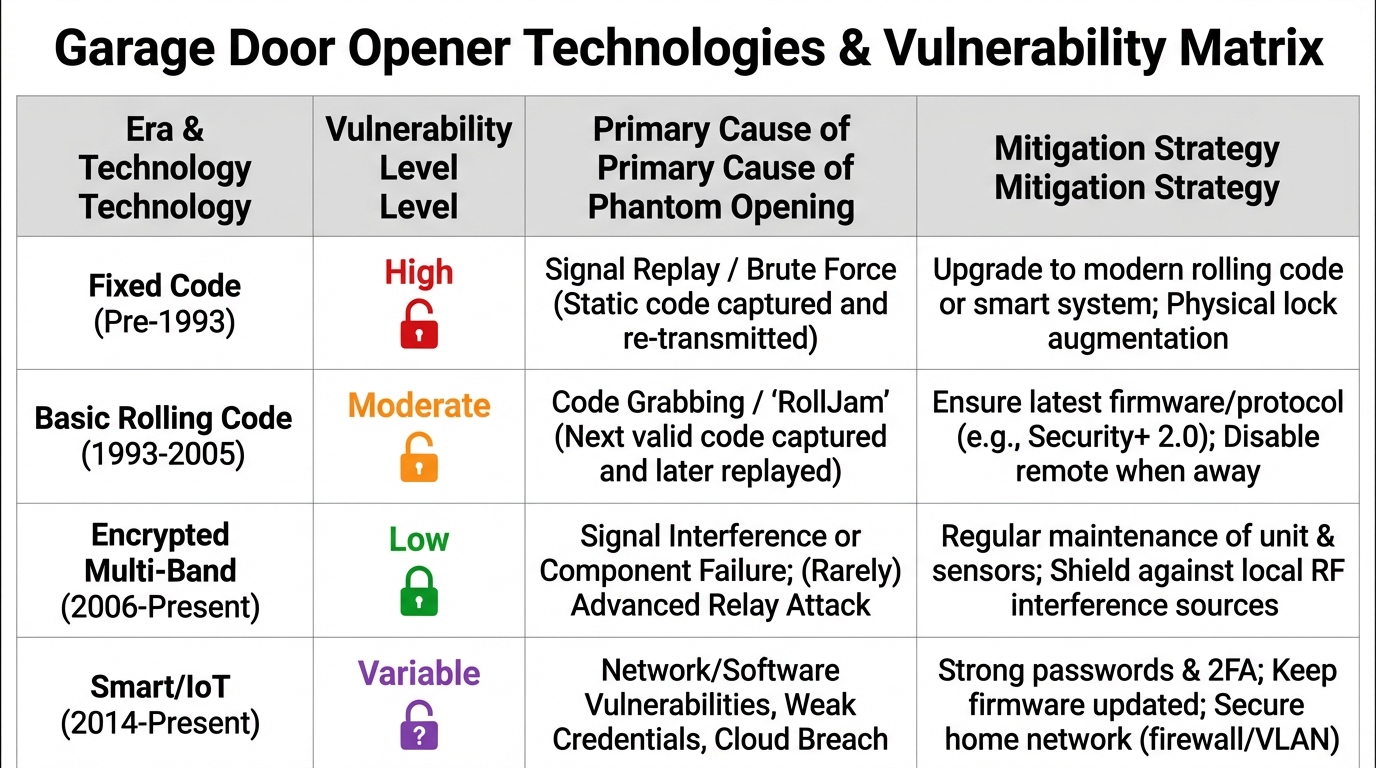
This comprehensive comparison shows how each generation of garage door technology addresses previous vulnerabilities while introducing new potential issues. Understanding your system’s technology helps narrow down the likely causes of phantom operation.
What’s Actually Causing Your Garage Door to Open By Itself?
Phantom operations stem from four primary categories: radio frequency interference, electrical failures, mechanical malfunctions, and smart home software glitches. Let’s examine each in detail.
A. Radio Frequency (RF) Interference
Garage door openers operate on unlicensed FCC Part 15 frequency bands, primarily 315 MHz and 390 MHz. Because these frequencies are shared with other consumer electronics and government operations, interference can trigger older receivers.
Common interference sources include:
- Malfunctioning household appliances
- Wireless weather stations
- LED light bulbs emitting electromagnetic interference
- Nearby military installations using Land Mobile Radio systems on overlapping frequencies
The Door & Access Systems Manufacturers Association identifies RF interference as one of the most frequent causes of intermittent opener malfunction in urban areas. The problem intensifies in densely populated neighborhoods where multiple devices compete for the same frequency space.
B. Electrical Short Circuits in Control Wiring
The low-voltage “bell wire” connecting your wall-mounted push button to the motor unit is a common failure point. If a metal staple securing the wire pierces the insulation, it creates an intermittent closed circuit. Structural vibrations from footsteps, wind, or HVAC operation can momentarily complete the circuit, which the motor interprets as a manual button press.
This is one of the most overlooked yet most common causes of phantom operation. The intermittent nature of these shorts makes them particularly difficult to diagnose without systematic testing.
C. Mechanical Hardware Failures (Stuck Buttons)
Physical wear on remote controls and wireless keypads can cause buttons to stick in the depressed position. Dirt, moisture, or degraded internal springs maintain contact with the circuit board, continuously sending open signals.
A remote control left in a hot car can experience thermal expansion, causing intermittent signal transmission. If the stuck remote is within range of your home—often 50 to 100 feet—it will continuously attempt to trigger the door, creating the appearance of spontaneous operation.
D. Smart Home Automation Glitches
IoT-enabled openers introduce software-related phantom operations. Common culprits include:
- Faulty geofencing routines that miscalculate GPS coordinates due to poor cellular reception
- Conflicting IFTTT applets or voice assistant routines
- Compromised Wi-Fi networks allowing unauthorized third-party app access
According to the National Institute of Standards and Technology, IoT device vulnerabilities are a growing cybersecurity concern. As smart home adoption increases, these digital triggers become as important to troubleshoot as traditional mechanical failures.
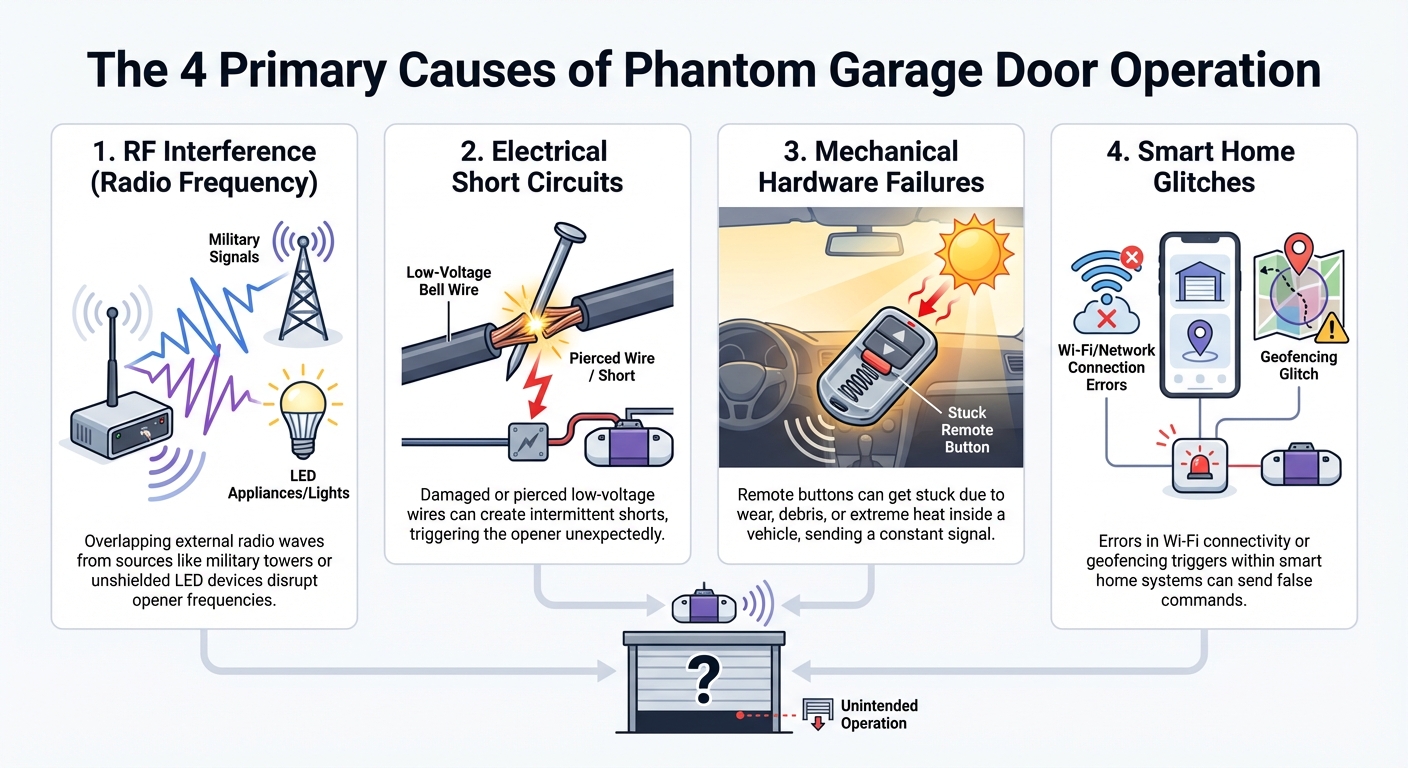
This visual breakdown helps you quickly identify which category might be affecting your system, guiding your troubleshooting efforts.
Case Studies: Military RF Interference & the “OpenSesame” Security Exploit
These documented cases illustrate how phantom operations aren’t just theoretical—they’ve affected thousands of homeowners and exposed critical security vulnerabilities.
Case Study 1: The Military RF Interference Phenomenon
In the early 2000s, homeowners near military installations—including Eglin Air Force Base in Florida and Naval Submarine Base New London in Connecticut—experienced widespread phantom garage door operations and complete system lockouts.
The root cause was straightforward but unavoidable: The Department of Defense upgraded Land Mobile Radio communication systems to the 380–399.9 MHz spectrum, the exact frequency used by millions of legacy garage door openers.
The FCC ruled that Part 15 unlicensed devices must accept interference from licensed government operations. Affected homeowners and garage door companies had to retrofit motors with dual-frequency or 315 MHz receivers to restore functionality.
Takeaway: If you live near a military base, airport, or emergency services facility, RF interference may be your culprit. Modern multi-frequency systems are specifically designed to avoid these conflicts.
Case Study 2: The “OpenSesame” Vulnerability (2015)
Security researcher Samy Kamkar demonstrated a critical flaw in legacy fixed-code garage door systems using a modified children’s toy. He transmitted all 4,096 possible DIP switch combinations in under 10 seconds, forcing phantom openings on demand.
This exploit was assigned CVE-2015-5201 by MITRE Corporation, proving that older fixed-code systems are completely defenseless against brute-force attacks. The security community urgently recommended upgrading to rolling code or encrypted systems.
Critical Security Warning: If your garage door system is pre-1993, you are vulnerable to this exact exploit. Upgrading isn’t just about convenience—it’s essential for home security.
The Real Cost of an Unsecured Garage Door
Beyond the annoyance factor, phantom garage door operation represents a genuine threat to your home security, property, and family safety.
Entry Point Statistics
The 9% of unauthorized residential entries that occur through the garage represent a significant vulnerability. Garages are often considered “soft targets” because homeowners leave the interior door to the house unlocked, assuming the garage door provides sufficient security.
An open garage provides unmonitored access to vehicles, tools, bicycles, and stored valuables. Unlike forced entry through windows or doors, garage entries often leave no visible signs of break-in, delaying discovery and police response.
Smart Home Security Market Growth
The global smart home security market is projected to reach $5.1 billion by 2025. As adoption increases, software-driven phantom openings will become as critical as mechanical failures. Homeowners must consider both physical and digital security protocols.
This market growth reflects increasing awareness of security vulnerabilities, but it also means more connected devices with potential failure points. Proper configuration and maintenance become increasingly important.
Pest and Environmental Exposure
An intermittently open garage door invites rodents, insects, and other pests that can spread throughout your home. Extreme weather exposure can damage stored items and compromise climate control efficiency. Long-term moisture intrusion can lead to mold growth and structural damage, creating health hazards and expensive repairs.
Insurance and Liability Considerations
Some homeowners insurance policies require functional garage door security systems. Documented phantom operations may affect claims if theft occurs through an unsecured garage. Maintaining your garage door system isn’t just about convenience—it’s about protecting your financial interests and meeting insurance obligations.
How to Diagnose and Fix Your Phantom Garage Door Problem
Follow this systematic, industry-standard diagnostic protocol to identify and resolve the root cause of your phantom operation issue.
Step 1: Isolate the Remotes (The Battery Test)
Remove batteries from all remote transmitters—handheld remotes, visor clips, and wireless keypads. Wait 24 to 48 hours and monitor for phantom operations.
If phantom operation stops, the issue is a stuck mechanical button on one of your remotes. Inspect each remote individually, cleaning buttons with isopropyl alcohol and replacing damaged units.
Pro Tip: Test remotes one at a time by reinstalling batteries individually to identify the faulty device. This methodical approach prevents confusion and ensures accurate diagnosis.
Step 2: Clear the Motor’s Memory
Erase all programmed devices from the garage door opener’s logic board. This ensures that lost, stolen, or neighbor-synced remotes cannot operate your door.
The process is straightforward:
- Locate the “Learn” button on your garage door motor unit, usually near the antenna wire
- Press and hold for 6 to 10 seconds until the indicator light turns off
- Reprogram only your current, verified remotes one at a time
Consult your specific manufacturer’s instructions for LiftMaster or Genie systems, as button locations and procedures vary slightly.
Step 3: Test the Wall Control Wiring
Disconnect the bell wires from the back of the motor unit and wait 24 hours. If phantom operation stops, you have an electrical short in the wiring or a faulty wall console circuit board.
Inspection process:
- Trace the wire path from the motor to the wall button
- Look for staples, screws, or nails that may have pierced the insulation
- Check for damaged sections near door frames, corners, or areas with structural movement
Replace damaged wire sections or the entire wire run if necessary. This relatively simple fix solves one of the most common phantom operation causes.
Step 4: Audit Smart Home Integrations
Review activity logs in your smart garage door app to identify unauthorized or unintended commands. Check for conflicting IFTTT applets, Alexa or Google Home routines with garage door commands, and overly sensitive geofencing triggers.
Security measures to implement:
- Change your Wi-Fi password and update to WPA3 encryption
- Enable two-factor authentication on smart home accounts
- Review NIST cybersecurity guidelines for IoT devices
- Remove any user accounts that shouldn’t have access
Modern smart home systems log every command, making it possible to trace unexpected openings to specific triggers or compromised accounts.
Step 5: Address LED Bulb Interference
Remove any LED bulbs installed in or near the garage door opener motor unit and wait 48 hours. Many inexpensive LED bulbs lack proper shielding and emit electromagnetic interference that disrupts the receiver.
If phantom operation stops, replace with “garage door opener compatible” LED bulbs or return to traditional incandescent bulbs. DASMA specifically recommends using only bulbs rated for garage door opener use, as the interference can be severe and intermittent.
Step 6: When to Call a Professional
If none of the above steps resolve the issue, the problem may be a failing logic board in the motor unit, severe local RF interference requiring frequency analysis, or a safety sensor malfunction triggering automatic reversal.
Smart Doors LLC recommends scheduling a professional diagnostic service to prevent ongoing security risks. Our technicians have specialized equipment to measure RF interference levels, test logic board functionality, and identify complex electrical issues that aren’t apparent through visual inspection.
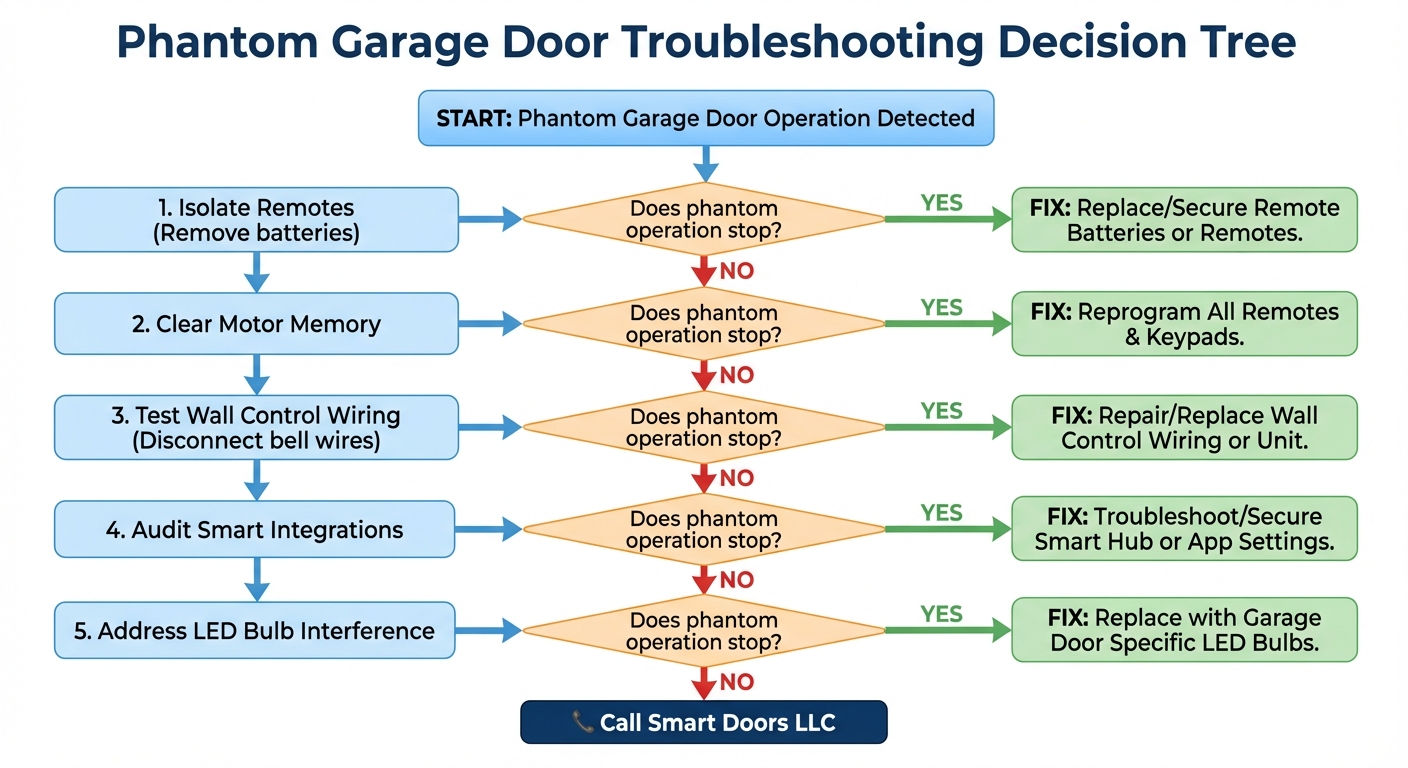
This decision tree provides a visual guide through the diagnostic process, helping you determine which step to take next based on your results.
Key Takeaways
Phantom garage door operation is more than a minor inconvenience—it’s a multifaceted security vulnerability that bridges mechanical wear, electrical failure, and modern digital risks. As this guide has shown, the causes range from simple stuck buttons and electrical shorts to complex RF interference from military installations and compromised smart home networks.
The good news? Most phantom operations can be diagnosed and resolved with systematic troubleshooting following the six-step protocol outlined above. For older systems still using fixed-code DIP switches, upgrading to a modern encrypted rolling code system isn’t just recommended—it’s essential for home security.
As Wi-Fi-enabled garage door openers become standard and the smart home security market approaches $5.1 billion by 2025, homeowners must adopt both physical and digital security protocols. Whether you’re dealing with a neighbor’s signal interference, a staple-pierced wire, or a misconfigured geofencing routine, understanding the root cause empowers you to take control.
If you’ve followed this troubleshooting guide and your garage door still opens on its own, it’s time to call the professionals. Smart Doors LLC specializes in diagnosing complex phantom operation issues, upgrading legacy systems, and integrating secure smart home solutions.
Restore Your Peace of Mind Today
Don’t let phantom garage door operations compromise your home security. Our expert technicians provide comprehensive diagnostics and lasting solutions.
References:
- U.S. Consumer Product Safety Commission. (2023). Safety Standard for Automatic Residential Garage Door Operators
- Cybersecurity & Infrastructure Security Agency. (2021). Security Guidelines for Smart Home Devices
- Federal Communications Commission. (2024). Understanding Unlicensed Part 15 Radio Frequency Devices
- Door & Access Systems Manufacturers Association. (2022). Technical Data Sheet 373: Garage Door Opener Radio Frequency Interference
- National Institute of Standards and Technology. (2022). Cybersecurity for the Internet of Things (IoT)
- Bureau of Justice Statistics. (2023). Victimization During Household Burglaries
- Statista. (2024). Smart Home Security Market Revenue Outlook
- MITRE Corporation. (2015). CVE-2015-5201 (Garage Door Fixed Code Vulnerability / OpenSesame)