Table of Contents
- The Language of a Noisy Garage Door: Popping vs. Grinding
- Rain, Rust, and Relative Humidity: How the PNW Climate Attacks Your Garage Door
- Not All Rollers Are Created Equal: Why Nylon Outperforms Steel in Damp Climates
- The Science of Silence: How Nylon Rollers Cut Garage Door Noise by 75%
- Protect Your Investment: Essential Maintenance Tips for PNW Homeowners
- Final Thoughts
Your garage door is the largest moving part of your home, operating multiple times every day—often without a second thought. But when those familiar hums transform into alarming pops or harsh grinding sounds, it’s more than just annoying. These noises are your door’s way of signaling mechanical wear, and in the Pacific Northwest, our climate accelerates that breakdown. The PNW’s infamous damp weather—with average relative humidity levels of 73-76%, often spiking above 80% during our wet season—creates the perfect storm for garage door component corrosion. Cities like Seattle and Portland experience prolonged rainfall from October through April, and that constant moisture wreaks havoc on exposed steel parts like rollers and hinges. In this guide, we’ll break down the science behind those unsettling sounds, explain why our regional climate makes the problem worse, and show you how upgrading to sealed nylon rollers can restore peace and quiet while extending your door’s lifespan. Whether you’re dealing with intermittent pops or constant grinding, understanding the root cause is the first step toward a lasting solution.
The Language of a Noisy Garage Door: Popping vs. Grinding
Not all garage door noises are created equal. Understanding the specific sounds your door makes is the key to diagnosing the underlying mechanical problem.
The “Popping” Phenomenon
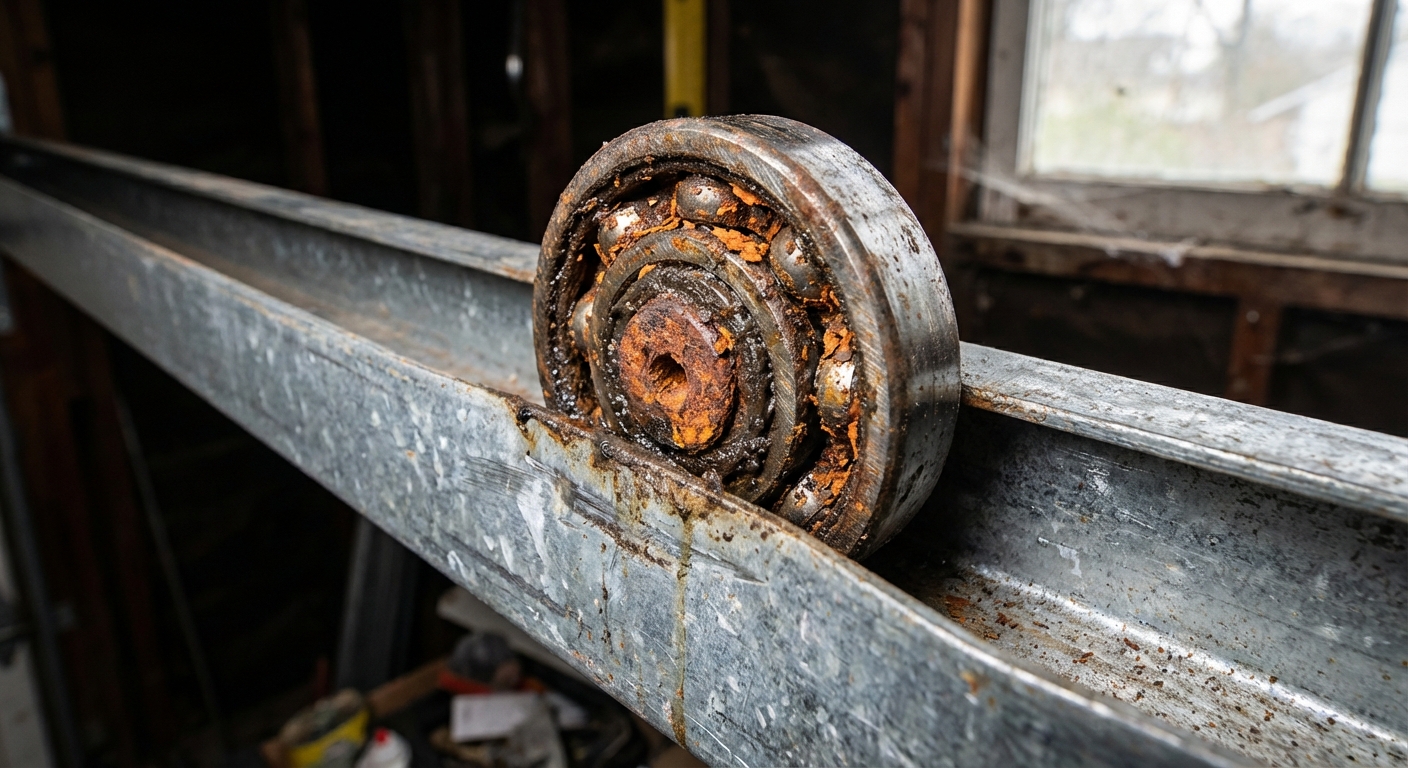
Popping sounds occur in discrete intervals, usually as the door moves through the curved portion of the track. The primary culprit? Oxidized or unlubricated hinges and worn roller stems. When hinges binding due to rust or lack of lubrication, they resist pivoting. As the opener forces the door upward, the hinge suddenly releases, creating a sharp “pop” that resonates through the door panels. There’s also a secondary cause: torsion springs that have accumulated rust can bind coil-to-coil, producing a popping sound as they forcefully slide past one another. Either way, your hinges or springs are crying out for lubrication—or they’ve already been compromised by corrosion.
The “Grinding” Phenomenon
Grinding is a continuous, harsh friction noise that persists throughout the door’s entire travel path. The primary cause is metal-on-metal contact. Standard unsealed steel rollers contain exposed ball bearings. When these bearings degrade, lose lubrication, or accumulate debris, they stop rolling smoothly. Instead, the metal roller drags across the galvanized steel track, creating a grinding sound while simultaneously shaving microscopic layers of metal off the track. This isn’t just a noise problem—it’s active mechanical degradation. Your rollers have likely seized, and your track is being damaged with every operation.
Why These Sounds Shouldn’t Be Ignored
Both popping and grinding indicate that your door’s components are experiencing abnormal stress and friction. Left unaddressed, these issues can lead to premature opener failure, warped tracks, and costly full-system replacements. The sooner you identify and fix the problem, the more money you’ll save in the long run.
Rain, Rust, and Relative Humidity: How the PNW Climate Attacks Your Garage Door
The Pacific Northwest’s unique weather conditions create an environment where standard steel garage door components corrode faster than in most other regions of the country.
The Science of Atmospheric Corrosion
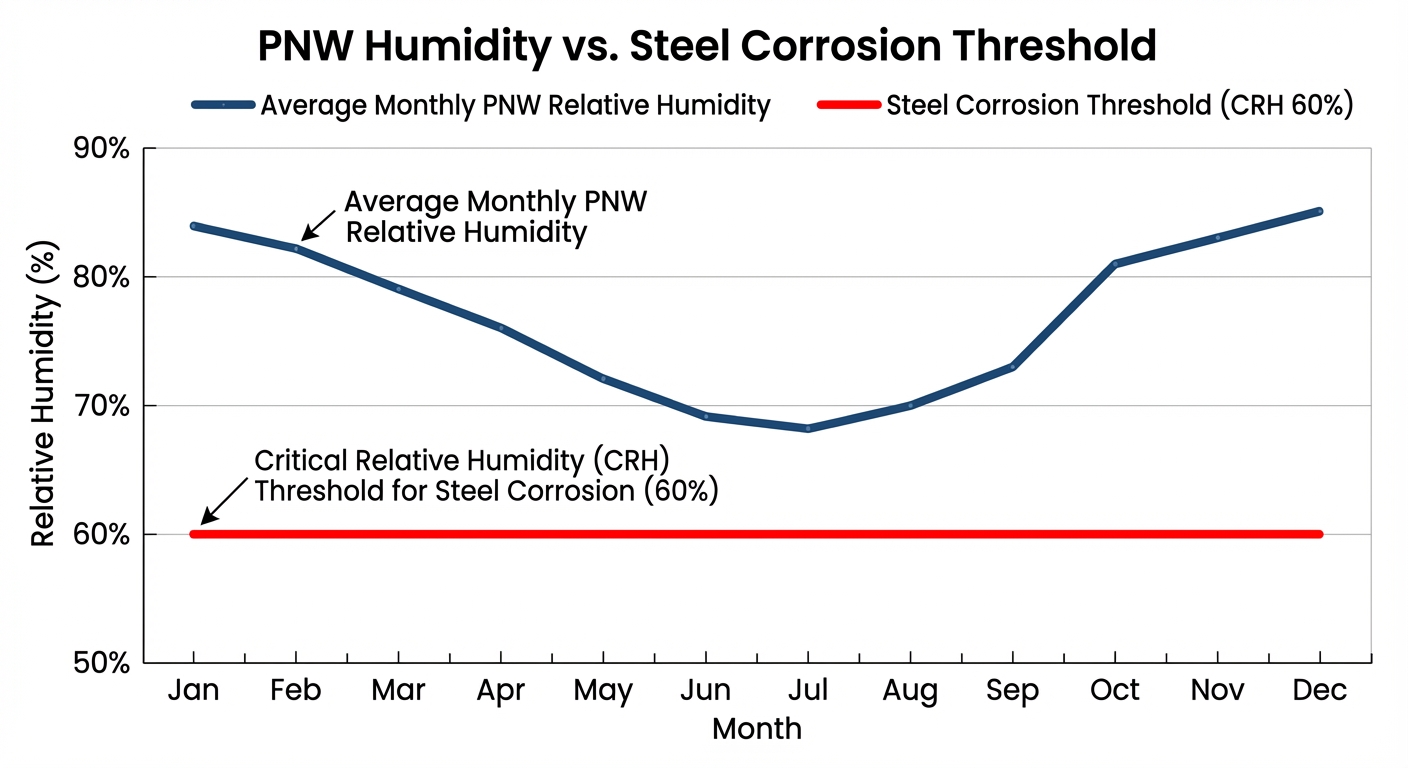
Atmospheric corrosion of carbon steel depends on the presence of moisture and oxygen. The “Critical Relative Humidity” (CRH) for steel is approximately 60%. Above this threshold, invisible layers of moisture condense on metal surfaces, acting as an electrolyte that initiates the electrochemical oxidation process—commonly known as rusting. This process doesn’t require standing water or direct rainfall. Even humid air is enough to trigger corrosion on exposed or minimally protected steel.
PNW Climate Data
According to the National Oceanic and Atmospheric Administration, cities like Seattle and Portland experience average annual relative humidity levels of 73% to 76%. During the wet season (October through April), RH frequently spikes above 80%. This means that for more than half the year, your garage door components are exposed to conditions that actively promote rust formation.
How This Impacts Your Garage Hardware
Standard garage door rollers and hinges are typically made of zinc-plated or bare carbon steel. The microscopic scratches incurred during daily operation quickly expose the underlying steel to the high-humidity environment. Once the protective zinc coating is breached, the exposed steel oxidizes rapidly, leading to seized rollers, binding hinges, and deteriorating tracks.
Real-World Consequences
In drier climates like Arizona or Nevada, unsealed steel rollers might last 7-10 years before showing significant wear. In the PNW, that same hardware often begins exhibiting corrosion-related failures in as little as 3-5 years. While this is a universal problem, the PNW’s prolonged exposure to high humidity makes it a regional specialty concern that requires climate-appropriate solutions.
Not All Rollers Are Created Equal: Why Nylon Outperforms Steel in Damp Climates
The choice between standard steel rollers and sealed nylon rollers isn’t just a matter of price—it’s a matter of engineering, longevity, and regional climate adaptation.
Standard Steel Rollers (The Builder-Grade Default)
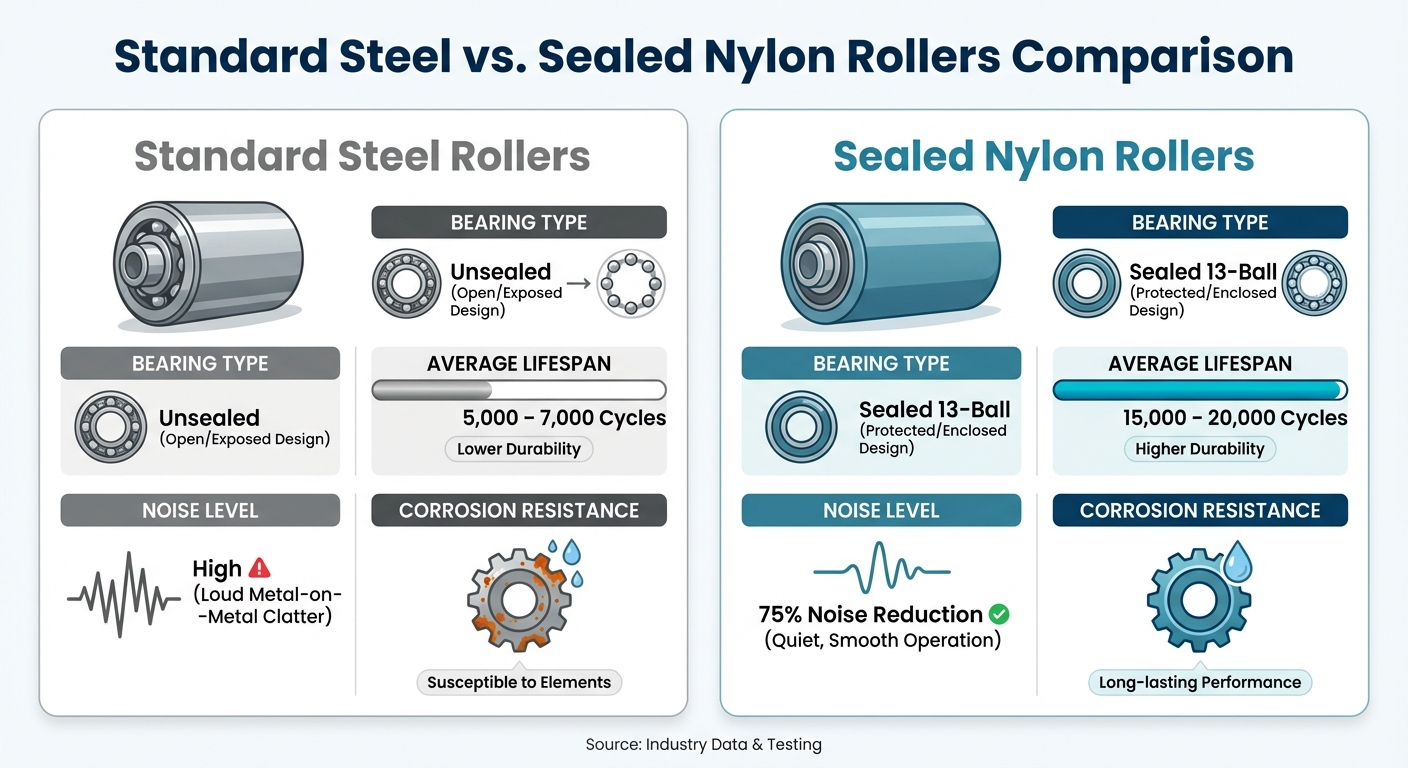
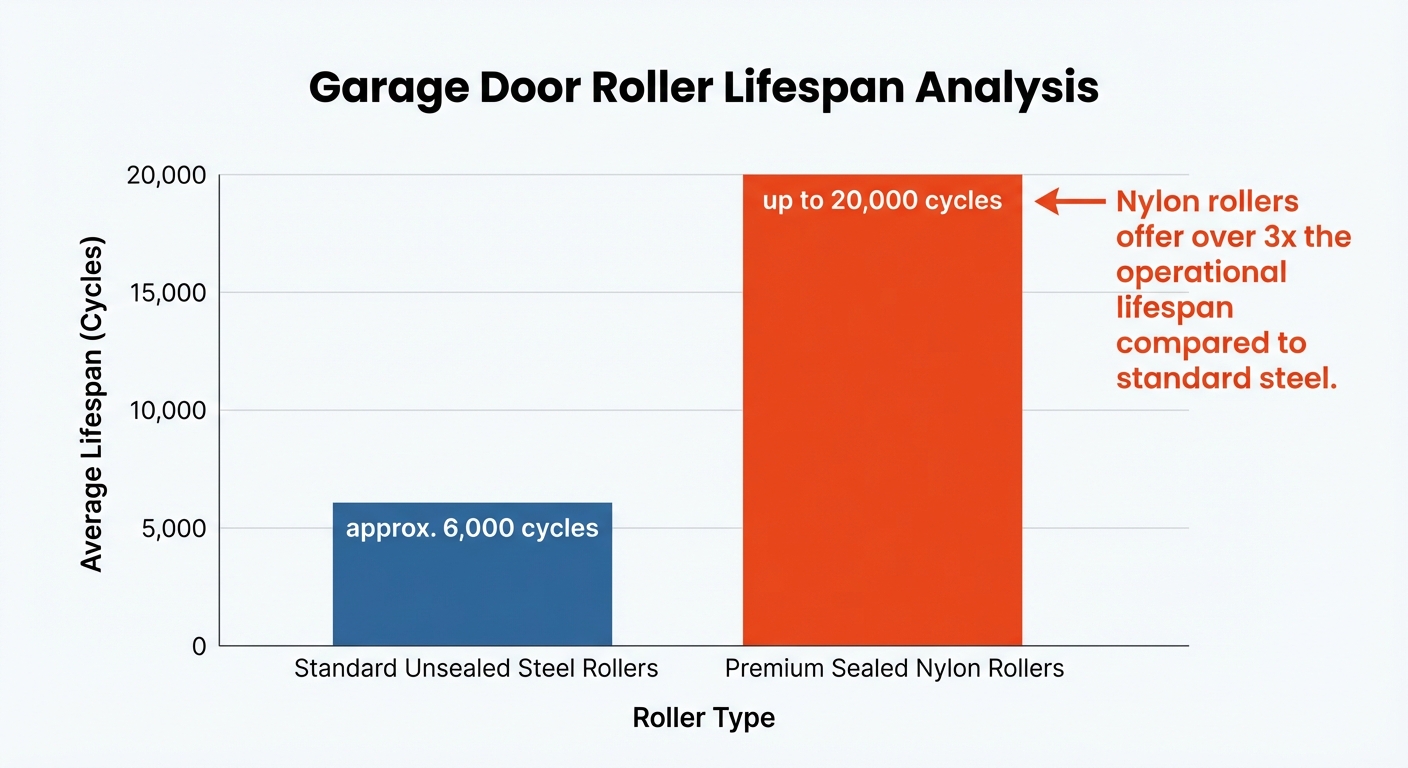
Standard steel rollers typically contain 7 to 10 unsealed ball bearings. Because the bearings are unsealed, dirt, pet hair, pollen, and airborne moisture easily infiltrate the bearing race. In the damp PNW weather, this moisture causes the bearings to rust and seize. These rollers are rated for approximately 5,000 to 7,000 door cycles—roughly 3 to 5 years of average use—before significant wear occurs. They produce high levels of noise because metal-on-metal vibration transfers through the track and into adjoining walls and living spaces. They also require frequent lubrication and inspection, which most homeowners neglect.
Sealed Nylon Rollers (The Upgrade Standard)
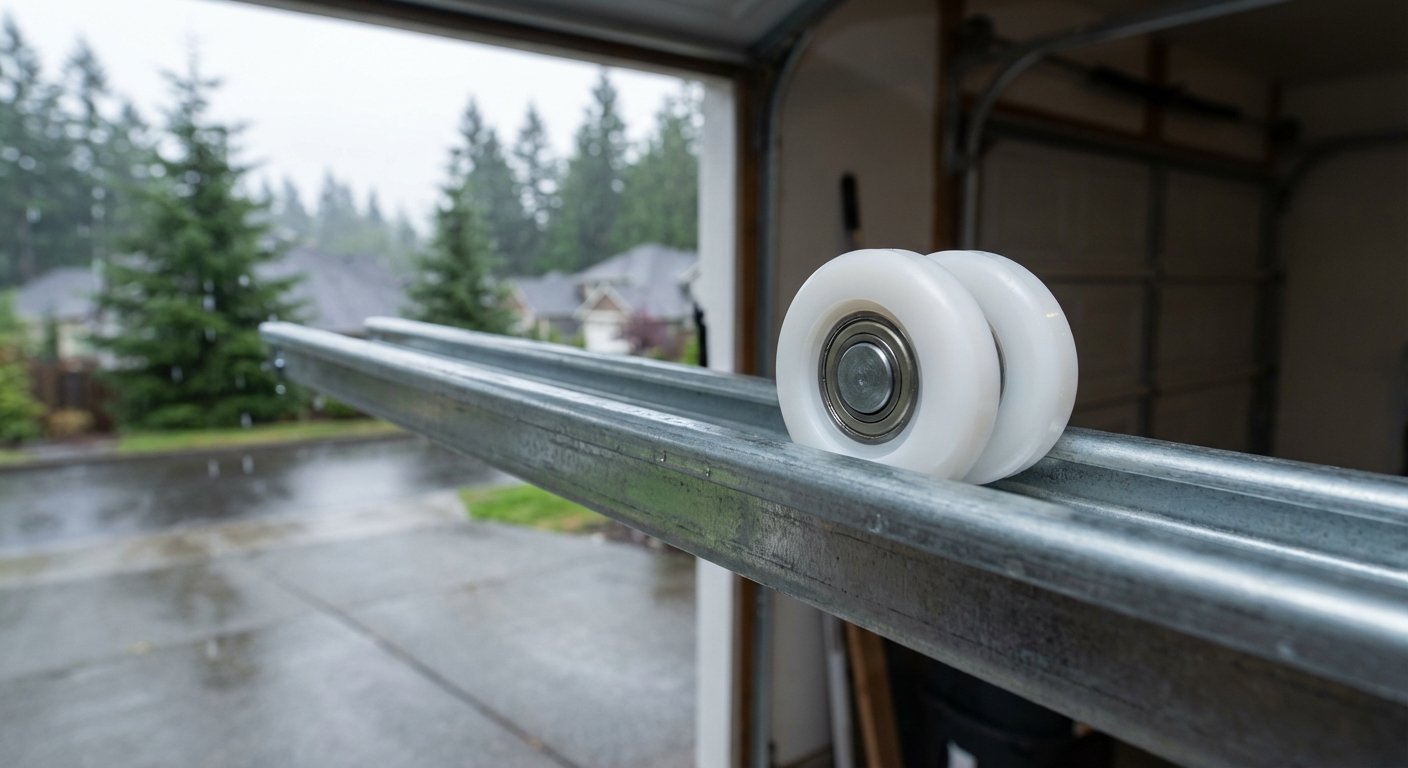
Sealed nylon rollers feature a solid wheel machined or molded from Nylon 6/6 (polyamide) attached to a steel stem. The highest quality variants feature a sealed 13-ball bearing system. Polyamide 6/6 is an engineering thermoplastic renowned for its high fatigue resistance, low coefficient of friction, and exceptional resistance to abrasion and environmental degradation. The sealed bearing prevents the ingress of moisture and particulate matter, effectively nullifying the PNW’s high-humidity threat to the internal rolling mechanism. These rollers are rated for 15,000 to 20,000 cycles—roughly triple the lifespan of standard steel rollers. Nylon’s lower acoustic impedance absorbs micro-vibrations rather than transferring them to the track. Field tests show noise reductions of up to 75%. Additionally, because nylon is softer than galvanized steel, even under heavy loads, it doesn’t abrade the track’s protective coating.
Why This Matters for PNW Homeowners
In a region where humidity is the enemy, sealed bearings are non-negotiable. Nylon rollers aren’t just quieter—they’re a climate-appropriate engineering solution that prevents the cascading failures common with steel rollers in wet environments. Here’s a quick comparison:
| Feature | Standard Steel Rollers (Unsealed) | Premium Sealed Nylon Rollers |
|---|---|---|
| Bearing Type | Unsealed (Exposed to elements) | Sealed 13-Ball Bearing |
| Average Lifespan | 5,000 – 7,000 Cycles | 15,000 – 20,000 Cycles |
| Noise Level | High (Metal-on-metal vibration) | Very Low (Polymer dampening) |
| Corrosion Resistance | Poor (Highly susceptible in PNW) | Excellent (Bearings protected) |
| Track Wear | High (Potential for grinding) | Minimal (Nylon absorbs friction) |
The Science of Silence: How Nylon Rollers Cut Garage Door Noise by 75%
Upgrading to nylon rollers doesn’t just prevent rust—it fundamentally changes the acoustic profile of your garage door system.
Acoustic Dampening (Noise Reduction)
Acoustically, a garage door track acts as a resonating chamber. When steel rollers move against steel tracks, the vibrations are transferred directly into the track, the garage walls, and the adjoining living spaces. Nylon 6/6 has a significantly lower acoustic impedance than steel. It acts as an acoustic isolator, absorbing the micro-vibrations rather than transferring them to the track. Industry tests and field observations consistently show that swapping steel rollers for 13-ball sealed nylon rollers can reduce operational noise by up to 75%.
Real-World Impact
For homeowners with bedrooms above or adjacent to the garage, this noise reduction is transformative. Early morning or late-night door operations no longer wake sleeping family members. The garage becomes a quieter, more pleasant workspace—and if you’re working on projects or using the space as a home gym, the difference is immediately noticeable.
Prevention of Track Degradation
When an unsealed steel roller seizes, it drags. Dragging strips the zinc-galvanized coating off the track. Once the raw steel of the track is exposed to the damp PNW air, the track itself begins to rust, eventually requiring a complete—and costly—hardware replacement. Nylon rollers are softer than the galvanized track; therefore, even under heavy loads, they do not abrade the track’s protective coating. This single factor alone can save you hundreds of dollars in track replacement costs.
Long-Term Cost Savings
While nylon rollers have a higher upfront cost (typically $3-5 per roller vs. $1-2 for steel), their extended lifespan and track preservation benefits result in significant long-term savings. Preventing track replacement alone can save homeowners $300-600 in parts and labor. When you factor in the reduced noise complaints, fewer service calls, and extended door life, the investment pays for itself multiple times over.
Protect Your Investment: Essential Maintenance Tips for PNW Homeowners
Even with upgraded components, proactive maintenance is essential for extending your garage door’s lifespan and preventing noise in the Pacific Northwest’s challenging climate.
The WD-40 Myth
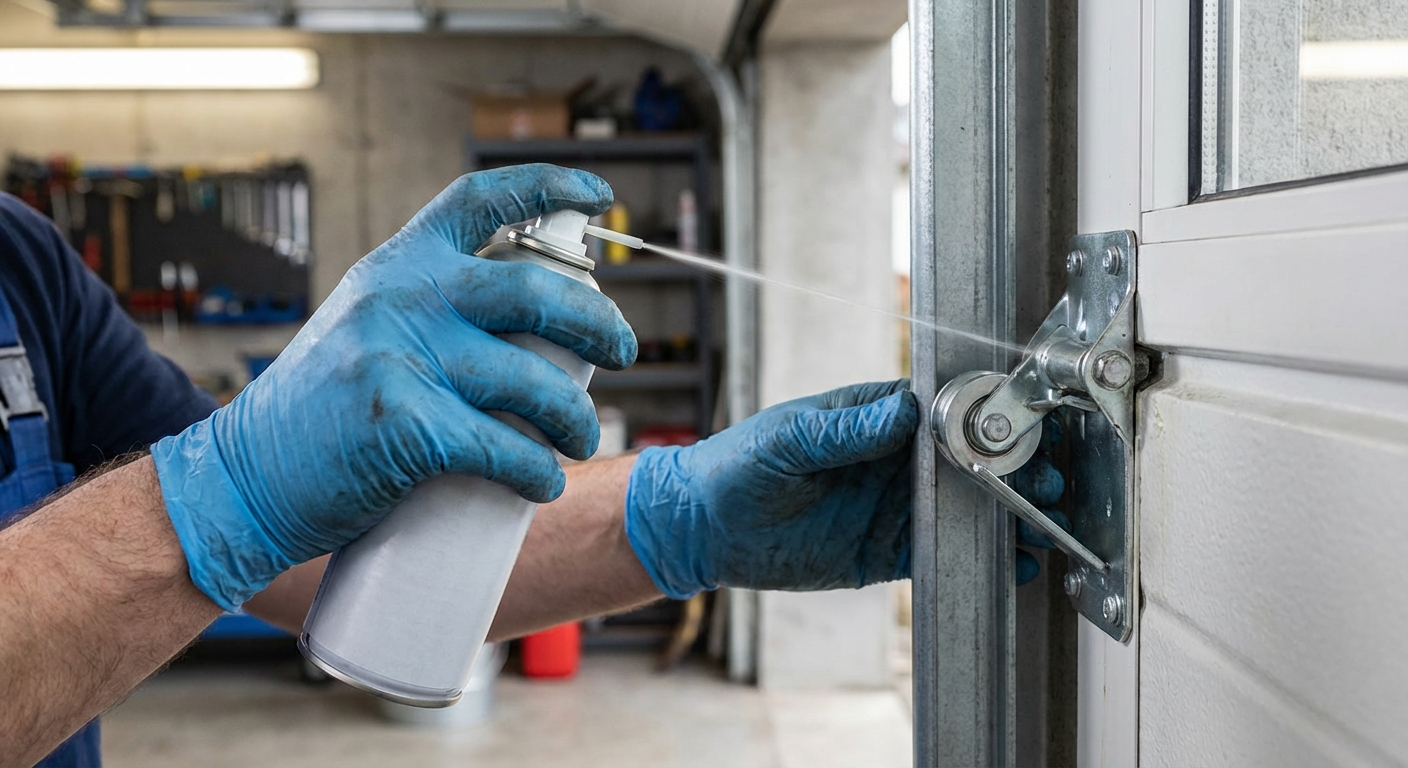
Many homeowners reach for WD-40 when their garage door starts making noise, but this is often counterproductive. Standard WD-40 is a degreaser and water displacer, not a long-term lubricant. It strips existing factory grease and leaves metal unprotected, accelerating rust in damp environments. The result? Short-term noise reduction followed by accelerated corrosion.
What to Use Instead
For steel hinges and torsion springs, a high-quality white lithium grease should be applied semi-annually to form a protective, moisture-resistant barrier. Silicone-based sprays are ideal for tracks and rollers because they repel moisture and don’t attract dust and debris. Apply lubricants every 6 months, ideally at the beginning and end of the wet season (October and April). This schedule ensures your components stay protected during the wettest months while refreshing protection after the season ends.
When Lubrication Isn’t Enough
If a door is already exhibiting the grinding sound, lubrication is often insufficient, as the internal ball bearings are likely destroyed. The solution? A full replacement with sealed nylon rollers is the most cost-effective long-term remediation. While nylon roller replacement can be a DIY project for mechanically inclined homeowners, professional installation ensures proper alignment and tensioning. Improperly installed rollers can cause premature wear or create new noise problems.
Seasonal Inspection Checklist
October (Pre-Wet Season):
- Inspect hinges and roller stems for early signs of rust
- Apply white lithium grease to all hinges
- Check track alignment and clean debris
April (Post-Wet Season):
- Re-lubricate all moving parts
- Inspect rollers for wear or binding
- Test door balance and opener operation
Why Smart Doors LLC Recommends Proactive Upgrades
Rather than waiting for catastrophic failure, proactive roller replacement during routine maintenance prevents costly emergency repairs. At Smart Doors LLC, we can assess your current hardware during service calls and recommend climate-appropriate upgrades that will save you money and headaches down the road.
Final Thoughts
If your garage door is popping or grinding, it’s not just a minor annoyance—it’s a mechanical cry for help. In the Pacific Northwest, our climate’s high humidity and prolonged wet season accelerate the corrosion and wear of standard steel components, making noise problems more common and more urgent than in drier regions. The good news? You don’t have to live with the noise. Upgrading to sealed nylon rollers is a scientifically sound, climate-appropriate solution that cuts operational noise by up to 75%, extends component lifespan by triple, and protects your tracks from degradation. Combined with proper lubrication and seasonal maintenance, this upgrade can restore your garage door to whisper-quiet operation while saving you money on future repairs. At Smart Doors LLC, we understand the unique challenges PNW homeowners face. Whether you’re dealing with early-stage corrosion or a door that sounds like it’s tearing itself apart, we’re here to help with expert diagnostics, quality parts, and professional installation.
Ready to Silence Your Garage Door?
Don’t wait for a complete breakdown. Get expert help today and restore peace and quiet to your home.
References:
- Door & Access Systems Manufacturers Association (DASMA). (2020). Technical Data Sheet 167: Garage Door Maintenance. https://www.dasma.com/technical-data-sheets/
- ASM International. (2018). Tribology and Friction: Wear of Metal Interfaces in Track Systems. https://www.asminternational.org/materials-resources/tribology-friction
- AMPP (Association for Materials Protection and Performance, formerly NACE). (2021). Atmospheric Corrosion of Carbon Steels. https://www.ampp.org/technical-resources/corrosion-basics/atmospheric-corrosion
- National Oceanic and Atmospheric Administration (NOAA). (2023). Comparative Climatic Data: Average Relative Humidity by City. https://www.ncdc.noaa.gov/ghcn/comparative-climatic-data
- DASMA. (2019). Understanding Garage Door Cycle Ratings (TDS 163). https://www.dasma.com/technical-data-sheets/
- MatWeb Material Property Data. (2024). Polyamide 6/6 (Nylon 6/6) General Characteristics. https://www.matweb.com/search/DataSheet.aspx?MatGUID=nylon66
- National Institute for Occupational Safety and Health (NIOSH). (2022). Acoustic Dampening Properties of Industrial Polymers vs. Metals. https://www.cdc.gov/niosh/topics/noise/acoustic-dampening.html
- International Journal of Fatigue. (2020). Fretting Fatigue and Wear of Galvanized Steel Surfaces. https://www.sciencedirect.com/journal/international-journal-of-fatigue
- WD-40 Company Technical Data. (2023). Understanding WD-40 Multi-Use Product vs. Specialist Lubricants. https://www.wd40.com/myths-legends-fun-facts/