Table of Contents
- Understanding the Counterweight System: How Your Garage Door Actually Works
- Why Garage Door Cables Snap: Understanding Progressive Metal Fatigue
- Why DIY Cable Replacement Can Result in Severe Injury or Death
- Beyond Replacement: Why Professional Calibration Saves You Thousands in Long-Term Costs
- Early Detection Saves Lives: The Warning Signs of Impending Cable Failure
- Final Thoughts
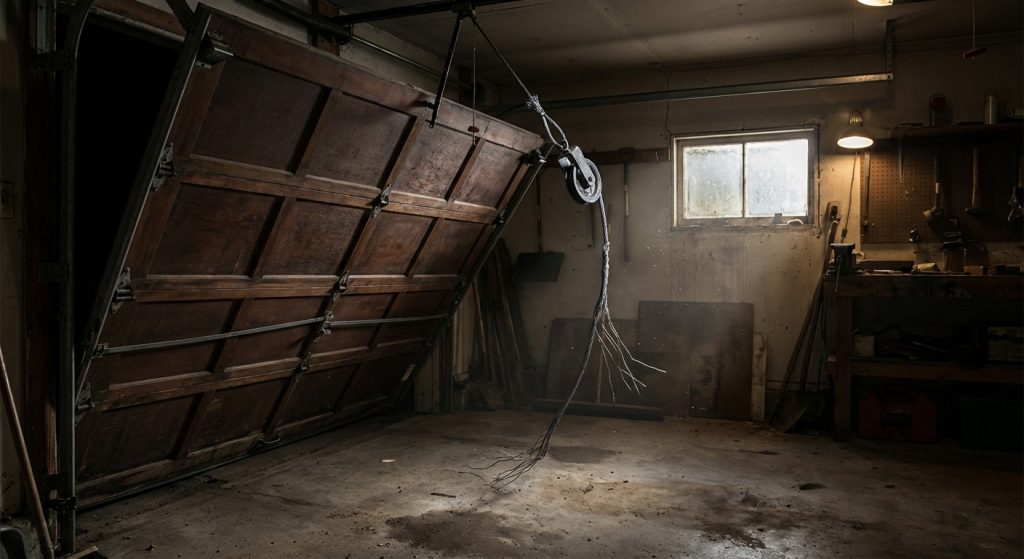
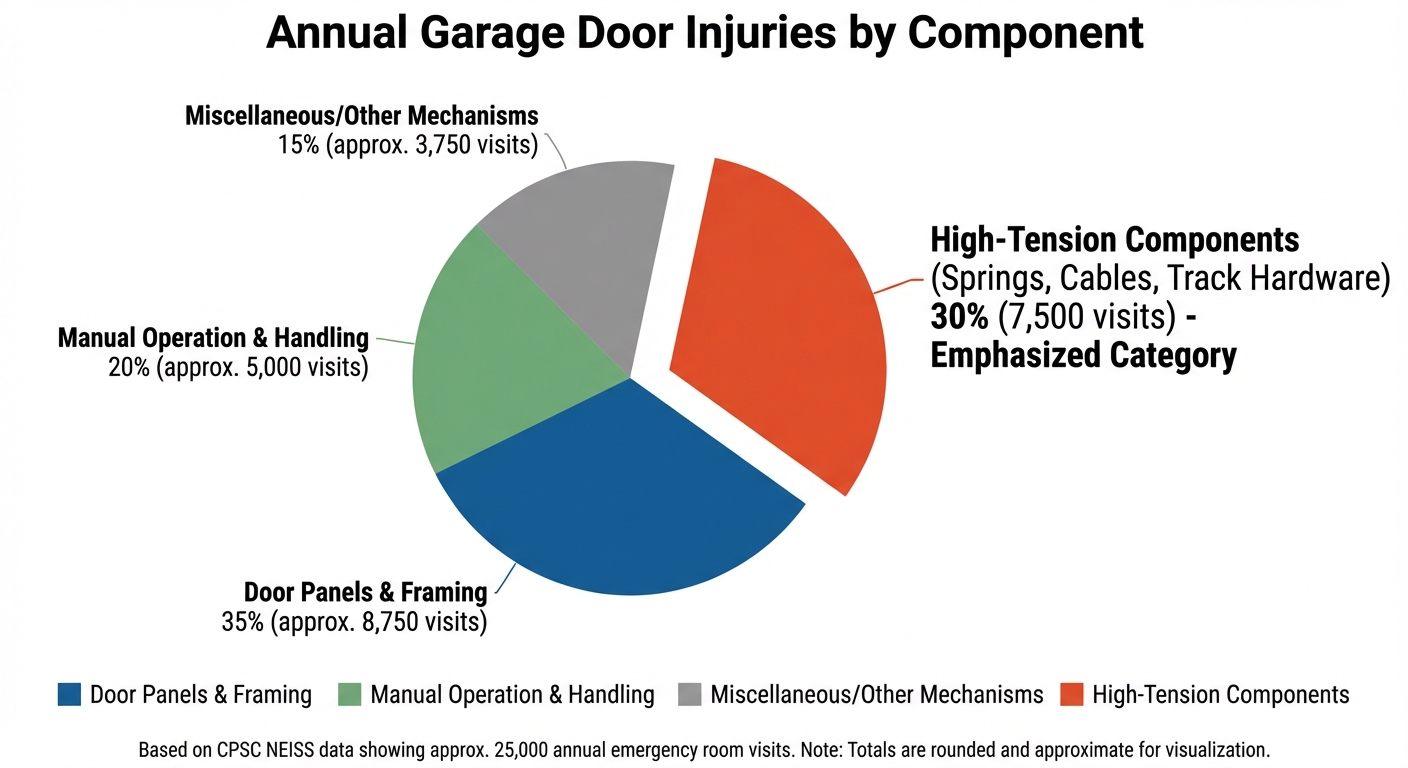
Picture this: You press the button to open your garage door, and instead of the familiar smooth glide upward, you hear a sharp metallic snap. The door lurches to one side, hanging crooked and jammed halfway up the track. What just happened? Your garage door cable—one of the most critical components in your home’s heaviest moving system—has failed catastrophically. Most homeowners never think about their garage door’s mechanical complexity until something goes wrong. But the reality is sobering: the average residential garage door weighs between 150 and 400 pounds, making it the heaviest moving object in most homes. And here’s what many people don’t realize—your electronic opener isn’t actually lifting that weight. The real heavy lifting is performed by high-tension springs and aircraft-grade steel cables working in perfect counterbalance harmony. When a cable snaps, this entire counterweight system fails in an instant, creating immediate safety risks that can result in severe injury. According to the Consumer Product Safety Commission (CPSC), an estimated 20,000-30,000 people are treated annually in emergency rooms for garage door-related injuries, with over 7,500 directly attributed to springs, cables, and track hardware. This isn’t just about a broken wire—it’s about managing a high-tension mechanical system capable of causing life-altering injuries and expensive property damage. In this article, we’ll explore the engineering behind your garage door, the three primary causes of cable failure, the extreme dangers of DIY repair attempts, and why professional laser-level precision is the only safe solution.
Understanding the Counterweight System: How Your Garage Door Actually Works
To appreciate why a snapped cable is such a serious emergency, you first need to understand how your garage door actually operates. Most homeowners assume the motorized opener does all the heavy lifting, but that’s a fundamental misconception. Your garage door opener is essentially just a motor that guides an already-balanced door along its tracks. The real lifting power comes from a sophisticated counterweight system of springs and cables under extreme tension.
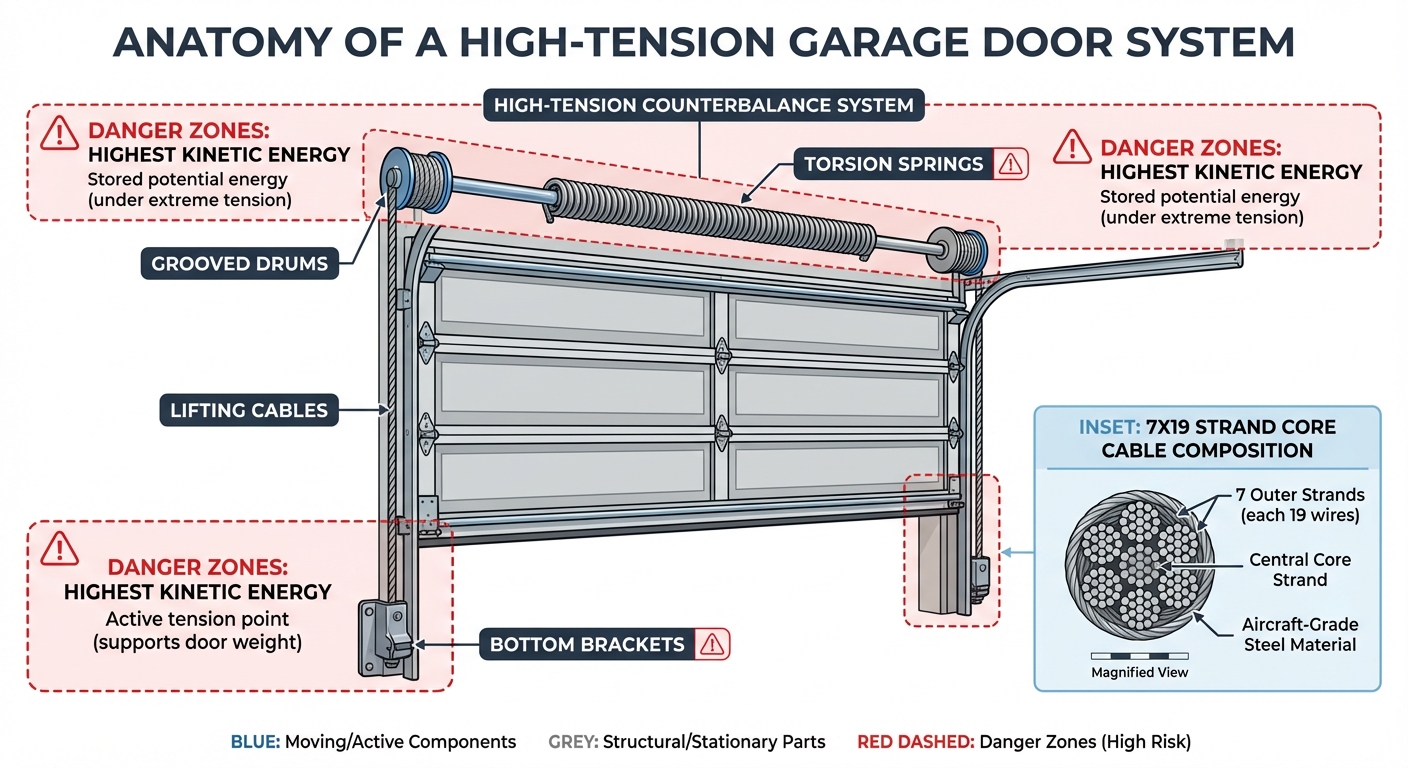
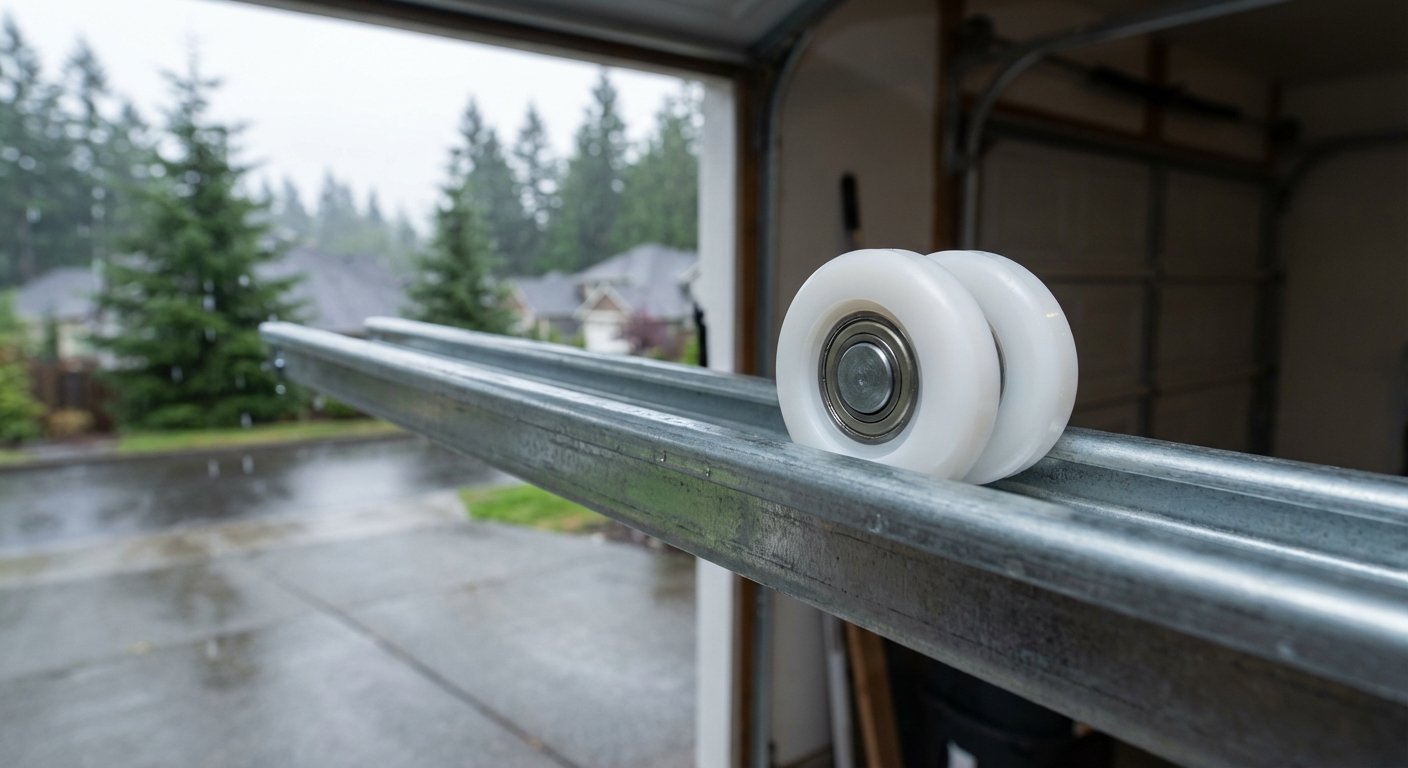
There are two primary types of counterbalance systems used in residential garage doors: Torsion Spring Systems feature springs mounted horizontally above the closed door. These springs twist (creating torsion) to store massive amounts of mechanical energy. Lifting cables attach to the bottom corners of the door and wind around grooved drums mounted at each end of the torsion shaft. When you open the door, the springs unwind, transferring their stored energy through the cables to lift the door’s weight. Extension Spring Systems use springs mounted above the horizontal tracks on each side of the door. These springs stretch to provide lifting force, working through a pulley system that transfers tension to the lifting cables. While less common in modern installations, many older homes still use this configuration. Regardless of the system type, the cables themselves are engineering marvels. They’re constructed from 7×19 strand core aircraft-grade galvanized steel wire rope—meaning seven strands, each containing nineteen individual wires, precisely braided together. This construction provides maximum flexibility while maintaining incredibly high tensile strength, allowing these thin cables to safely handle hundreds of pounds of force. Here’s the critical point that many homeowners miss: when your garage door is in the closed position, the cables are holding maximum kinetic energy. All that stored force is just waiting to release. A properly balanced garage door should require only 5-10 pounds of force to lift manually—try it yourself (with the opener disconnected for safety). If your door is balanced correctly, you should be able to raise it smoothly with one hand. The automatic opener isn’t doing heavy lifting; it’s simply automating the movement of an already-balanced system.
Why Garage Door Cables Snap: Understanding Progressive Metal Fatigue
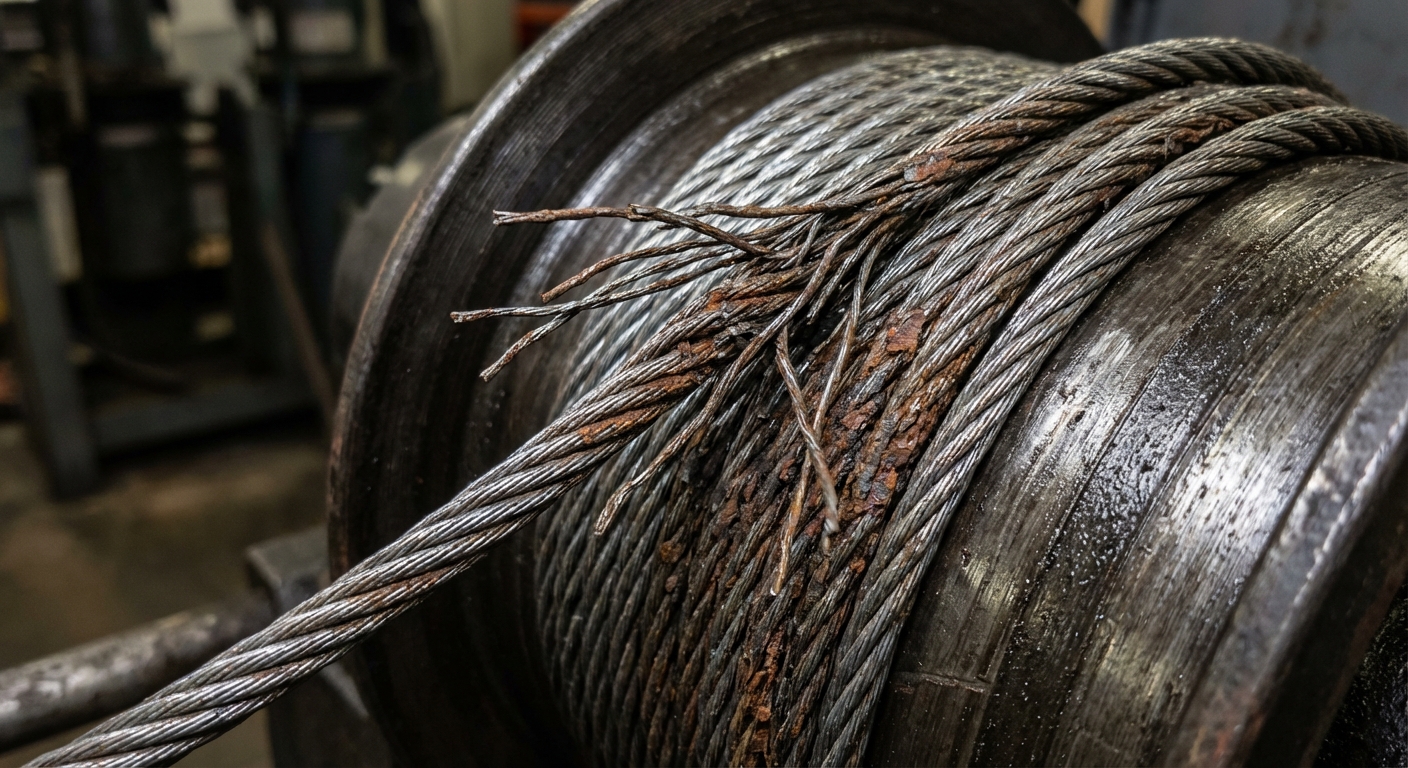
Garage door cables rarely fail without warning. Understanding the three primary failure mechanisms helps you recognize early warning signs and appreciate why professional intervention is necessary before complete failure occurs.
1. Cyclic Metal Fatigue
Every single time your garage door opens and closes, the cables bend around drums or pulleys, creating stress points in the metal. This repeated bending causes micro-fractures in the individual wire strands—a process that material engineers call “cyclic fatigue.” Think about bending a paperclip back and forth repeatedly. Eventually, the metal weakens at the bend point and snaps. The same principle applies to garage door cables, though on a much larger and more dangerous scale. If you open and close your garage door twice daily (once in the morning, once in the evening), that’s over 700 stress cycles per year. Over a decade, that’s more than 7,000 cycles of tension, release, and bending. The first visible sign of this progressive failure is fraying—individual wire strands breaking free from the cable core. If you ever notice loose wire strands protruding from your garage door cable, do not ignore this warning. It means the cable has already lost a significant percentage of its tensile strength and could fail completely at any moment.
2. Corrosion and Oxidation
Environmental factors dramatically accelerate cable deterioration. Humidity, road salt (especially common in coastal areas or regions with harsh winters), and lack of proper lubrication all contribute to metal oxidation—commonly known as rust. When the protective galvanized coating on steel cables begins to break down, the underlying metal oxidizes. This rust formation has two devastating effects: it dramatically increases friction between the cable and its hardware, and it degrades the tensile strength of the steel itself. A corroded cable can fail at loads far below its original rated capacity. This is why regular maintenance matters. Cables should be inspected and lightly lubricated during professional garage door maintenance visits. Neglecting this preventive care can reduce cable lifespan by 40-60%, turning a 15-year component into a 6-year failure waiting to happen.
3. Friction and Misalignment
Even slight misalignment of cable drums or bent door tracks can cause cables to scrape against hardware during operation. This abrasive friction acts like a saw, rapidly wearing through the wire rope. Here’s where DIY repairs often make things worse: homeowners attempting to adjust track alignment without proper tools and expertise frequently worsen the problem, accelerating cable wear rather than fixing it. Professional technicians use precision measuring tools to ensure perfect alignment—tolerances measured in fractions of an inch—that simply can’t be achieved by eyeballing the problem.
Why DIY Cable Replacement Can Result in Severe Injury or Death
This section contains the critical safety message every homeowner needs to understand: attempting cable repair without professional training and equipment exposes you to catastrophic injury from high-tension releases, amputation risks, and system collapse.
The Physics of Stored Kinetic Energy
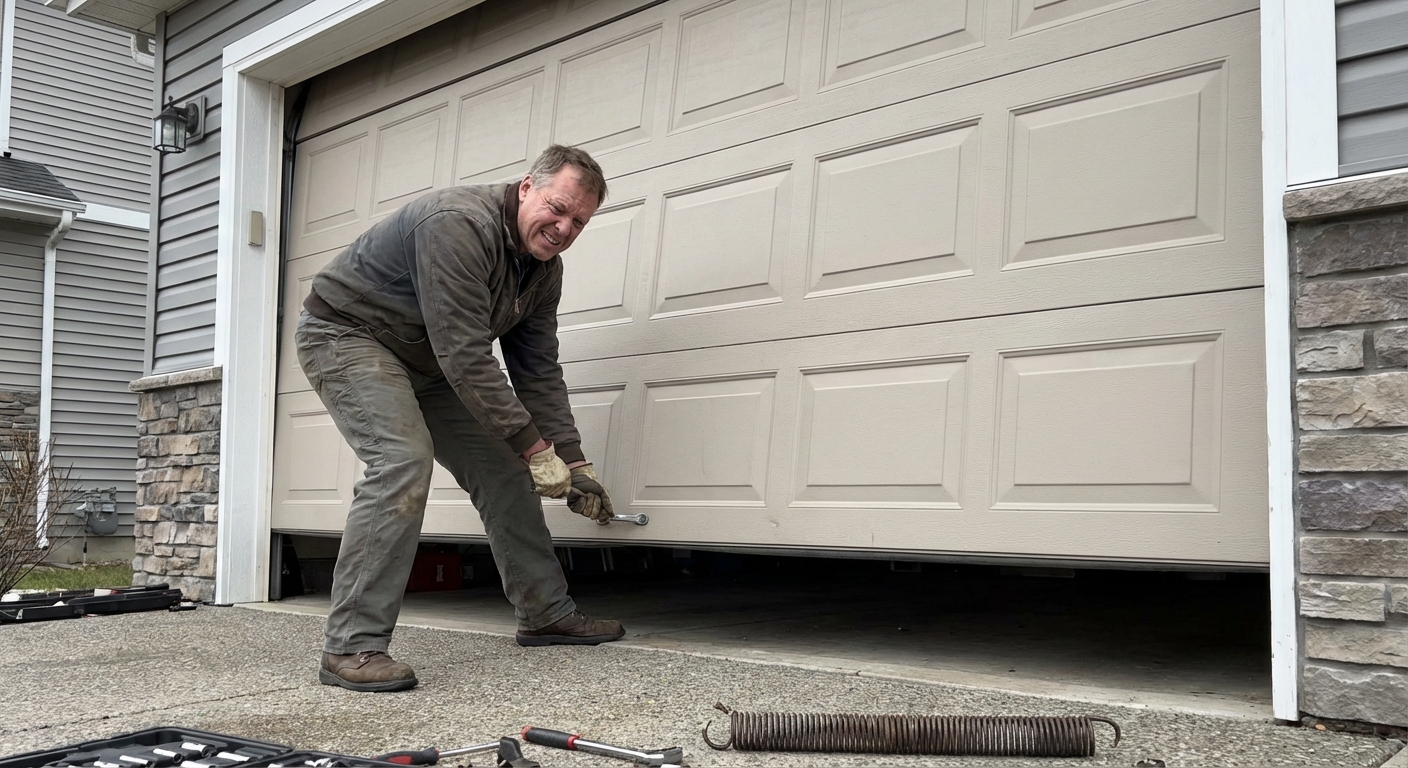
When a cable breaks, the entire weight of your garage door is suddenly forced onto the remaining cable, creating dangerous asymmetric loading. The door tilts, binds in the tracks, and becomes structurally unstable. But the real danger comes when someone attempts to “fix” the problem. If you try to cut a frayed cable or unscrew a bottom bracket while the system is still under tension, hundreds of pounds of stored kinetic energy release instantly. Metal cables can snap back at velocities exceeding 100 miles per hour—faster than you can possibly react. The results are devastating: facial fractures, severe lacerations requiring emergency surgery, crushed fingers, and permanent nerve damage.
CPSC Safety Alert on Bottom Brackets
The Consumer Product Safety Commission issued a specific safety alert regarding bottom bracket injuries. The bottom brackets are the metal fixtures at the base of the door where lifting cables attach. They’re under constant extreme tension when the door is closed. Documented cases show homeowners attempting to remove these brackets while springs were still tensioned suffered facial fractures when the brackets violently kicked outward with tremendous force. Others suffered severe hand lacerations requiring emergency surgery and resulting in permanent nerve damage. In one documented case, medical bills exceeded $15,000—far more than professional repair would have cost. The CPSC’s recommendation is unequivocal: Never touch any component attached to lifting cables without professional de-tensioning procedures.
The Cascading Failure Scenario
Even if you somehow avoid immediate injury, attempting to force a door with a broken cable open or closed creates additional dangers:
- The door could fall completely off its tracks, creating a crushing hazard
- Fingers can become caught and amputated in track rollers or hinges
- The remaining “good” cable can snap under the asymmetric load
- The entire door can collapse, causing property damage to vehicles parked below
Of those 20,000-30,000 annual emergency room visits for garage door injuries, a significant percentage involve homeowners who attempted DIY repairs on damaged systems. Many of these injuries could have been completely prevented by calling a professional technician.
Professional Safety Protocols Smart Doors LLC Employs
Professional technicians don’t just have experience—they have specialized equipment designed specifically for safely working with high-tension systems:
- Calibrated winding bars engineered to handle the extreme torque of torsion springs without slipping
- Locking pliers and safety clamps that secure the door in position during repairs
- Proper de-tensioning procedures that safely release stored energy before any component removal
- Safety glasses, gloves, and protective equipment as standard operating procedure for every service call
This isn’t optional equipment or “nice to have” tools. These are essential safety devices that prevent the catastrophic injuries documented by the CPSC.
Beyond Replacement: Why Professional Calibration Saves You Thousands in Long-Term Costs
Let’s say, hypothetically, that a homeowner somehow manages to replace a broken cable without suffering injury. They might feel proud of themselves for saving a few hundred dollars on professional service. But here’s what they don’t know: improper calibration causes cascading mechanical failures that will destroy their automatic opener, strip gears, and require complete system replacement within months—turning their “savings” into a financial disaster.
The Precision Problem with DIY Repairs
The Door & Access Systems Manufacturers Association (DASMA) establishes technical standards for garage door installation and repair. These standards dictate that garage doors must be perfectly balanced and leveled to operate safely. “Perfectly” isn’t just a marketing term—it means tolerances measured in fractions of an inch. The common DIY failure pattern goes like this: the homeowner successfully attaches the new cable, but fails to tension both sides equally. They might get one side perfect, but the other side has just a quarter-inch more or less cable wound around the drum. To the naked eye, the door looks fine. It goes up and down. Problem solved, right? Wrong. That micro-imbalance is already destroying the system.
The Cascading Mechanical Failures
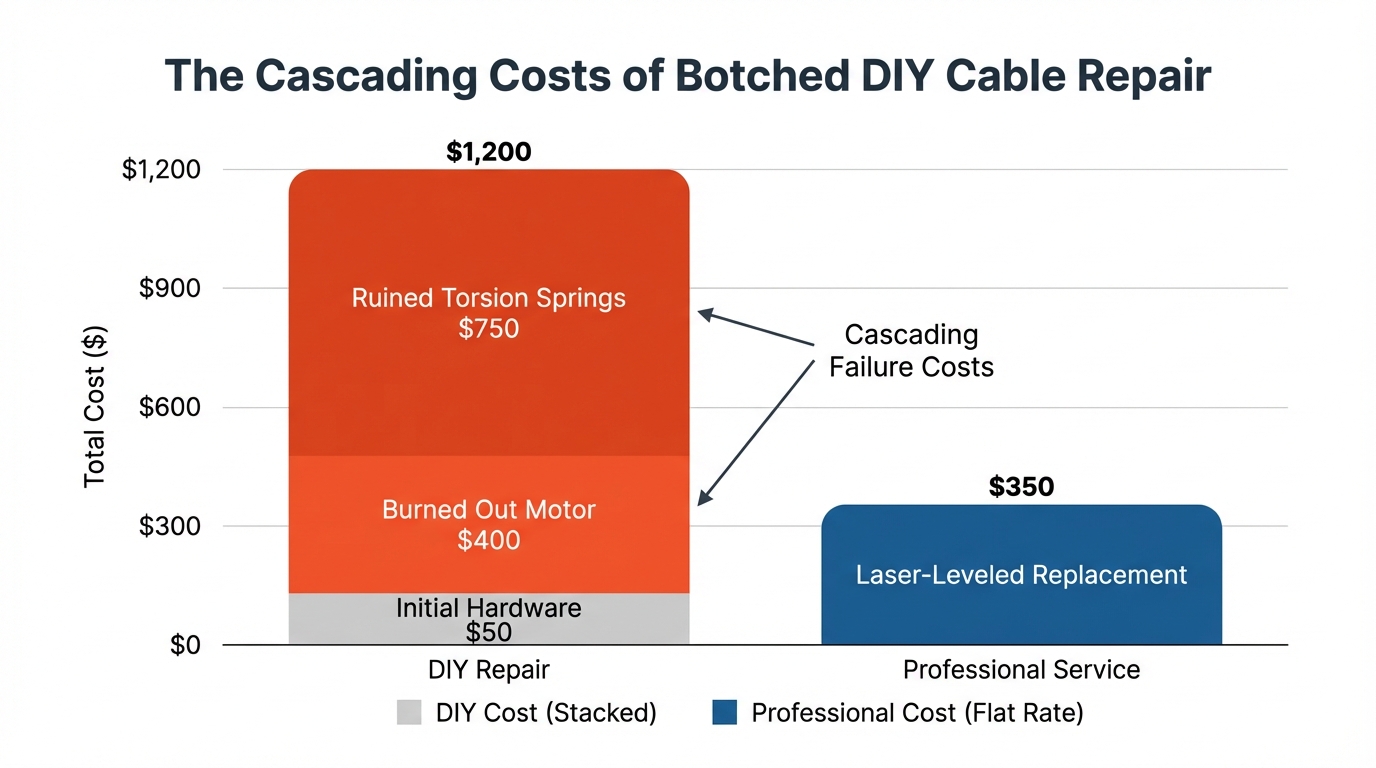
Here’s how the failure cascade progresses over the next 3-6 months: Month 1: The uneven cable tension causes the door to bind slightly in the tracks during operation. You might notice a small grinding noise, but it’s not terrible yet. Month 2-3: The continuous binding creates excessive friction, forcing your automatic opener motor to work harder than designed. The motor runs hotter, drawing more electrical current, slowly degrading its components. Month 4-5: The plastic gears inside the opener begin to strip under the abnormal load. You hear more clicking and grinding noises. The door occasionally doesn’t open on the first try. Month 6: The opener motor burns out completely. The uneven weight distribution has also accelerated wear on track rollers and hinges. Now you need to replace the entire opener ($800-1,500) plus repair the damaged tracks and hardware—versus the original $200-400 professional cable repair would have cost.
Case Study: The Six-Month Cascade
An InterNACHI home inspection report documented exactly this scenario: A homeowner replaced the left-side cable after it snapped, but left the slightly stretched right-side cable in place, thinking they were saving money by only replacing one cable. Because the old cable was longer due to metal fatigue, the door raised at a micro-angle invisible to the homeowner but devastating to the mechanical system. Over six months:
- The rollers ground into the tracks, creating grooves that caused binding
- The asymmetric stress caused the torsion spring to snap prematurely
- The $400 automatic opener motor burned out from excessive load
- Total repair cost: $1,200—versus $350 if professionally repaired initially
Professional Laser-Level Precision Process
When Smart Doors LLC performs a cable repair, the process goes far beyond simply attaching new wire:
- Complete system de-tensioning using calibrated winding bars to safely release spring pressure
- Simultaneous cable replacement on both sides (never just one cable)
- Laser-leveling tools to ensure the door sits perfectly flush against the concrete floor
- Synchronized drum winding that guarantees the exact same amount of cable is spooled on both left and right drums
- Balance testing to confirm the door can be lifted manually with minimal force (5-10 pounds)
- Final operational testing through 5-10 complete cycles to verify smooth, symmetric travel
The difference between DIY and professional repair isn’t just about safety during the repair itself—it’s about the long-term integrity of your entire garage door system.
| Metric | DIY Homeowner Repair | Professional Repair (Smart Doors LLC) |
|---|---|---|
| Safety Risk | Extremely High (laceration/amputation risk) | Low (professional safety protocols) |
| Leveling Accuracy | Visual estimation (0.5″-1″ unevenness) | Laser-level precision (perfectly flush) |
| Long-Term Cost | High (motor burnout within 6 months) | Low (balanced door extends opener life) |
| Hardware Quality | Generic hardware store cables | OEM/aircraft-grade cables calibrated to door weight |
Early Detection Saves Lives: The Warning Signs of Impending Cable Failure
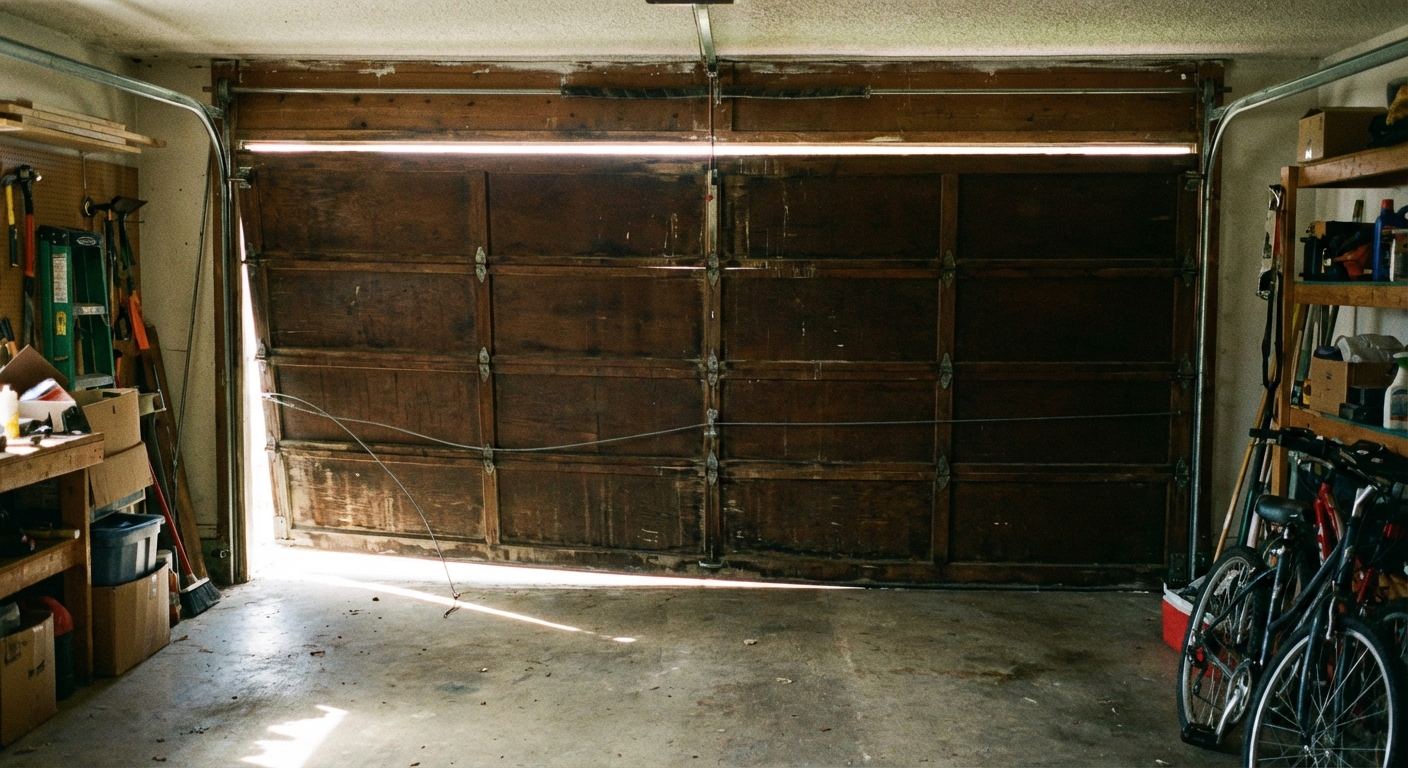
Proactive homeowners who recognize early warning signs can schedule professional inspection before catastrophic failure occurs, avoiding injury and minimizing repair costs.
Visual Inspection Warning Signs
Walk into your garage and take a close look at your lifting cables. Here’s what should concern you: Frayed or broken wire strands: If you see individual wires protruding from the cable core, the cable has already lost significant strength and requires immediate professional inspection. Rust or corrosion: Reddish-brown discoloration on cables indicates oxidation and strength degradation. Even light surface rust should be evaluated. Slack or loose cables: When your door is closed, cables should be taut. Any slack indicates spring failure, drum problems, or cable stretch.
Operational Warning Signs
Pay attention to how your door sounds and moves: Door hangs crooked or uneven: If one side is lower than the other during opening or closing, you have asymmetric tension—a sign of impending cable or spring failure. Jerky or hesitant movement: A healthy door glides smoothly. Stuttering, catching, or hesitation indicates friction, binding, or component failure. Excessive noise: Grinding, scraping, or squealing sounds during operation point to friction or misalignment that’s actively destroying your cables. Door won’t stay open manually: Disconnect your opener and manually lift the door halfway. A properly balanced door should remain stationary. If it falls, your counterweight system has failed.
Emergency Situations Requiring Immediate Professional Service
Some symptoms require you to stop using the door immediately and call Smart Doors LLC for emergency service:
- Sudden loud snap or bang: This usually indicates spring or cable failure. Do not attempt to operate the door—the counterweight system has failed and the full weight is unsupported.
- Door falls rapidly when opening: This means complete loss of counterweight support and creates extreme danger of crushing injury.
- Cable has completely detached: The door is structurally unsupported and could collapse at any moment.
- Bottom bracket has pulled away from door: This indicates hardware failure under extreme tension—an extremely dangerous situation.
Why Annual Professional Inspections Are Critical
Even without obvious symptoms, preventive maintenance dramatically extends the life of your garage door system and prevents catastrophic failures. Professional technicians can detect early-stage cable wear long before failure occurs. During a Smart Doors LLC annual inspection, our technicians:
- Perform visual inspection of cables for fraying, rust, or damage
- Conduct balance testing to verify symmetric operation
- Check and adjust spring tension if needed
- Lubricate cables, hinges, and rollers to extend component lifespan
- Identify any track misalignment or hardware wear
Final Thoughts
When a garage door cable snaps, you’re not dealing with a simple home repair project. You’re managing a high-tension mechanical system that holds hundreds of pounds of kinetic energy—a system capable of severe injury and property damage if mishandled. The combination of extreme mechanical forces, precision engineering requirements, and documented injury risks makes professional service the only safe and cost-effective solution. Those 7,500+ Americans who suffer cable and spring injuries each year aren’t inherently careless—they simply underestimated the complexity and danger of what they were attempting. Remember: even if you successfully replace a cable without injury, improper calibration destroys your automatic opener within months, turning a $300 repair into a $1,500 system replacement. The question isn’t whether to call a professional; it’s how quickly you can get one to your home.
Noticed Fraying Cables or Crooked Door Operation?
Don’t wait for catastrophic failure. Contact Smart Doors LLC for a comprehensive safety inspection and professional cable repair. Our laser-level precision ensures your family’s safety and protects your investment in your garage door system.
References:
- Occupational Safety and Health Administration (OSHA). Wire Rope Standards (1926.251(c)). United States Department of Labor. https://www.osha.gov/laws-regs/regulations/standardnumber/1926/1926.251
- American Society of Civil Engineers (ASCE). (2022). Fatigue and Fracture of Steel Wire Ropes. ASCE Library. https://ascelibrary.org/journal/jmcea3
- Consumer Product Safety Commission (CPSC). (2024). National Electronic Injury Surveillance System (NEISS) Data Highlights. https://www.cpsc.gov/Research–Statistics/NEISS-Injury-Data
- Consumer Product Safety Commission (CPSC). CPSC Warns About Garage Door Accidents (Safety Alert). https://www.cpsc.gov/s3fs-public/523_0.pdf
- Door & Access Systems Manufacturers Association (DASMA). (2023). Technical Data Sheet 163: Garage Door Springs & Cables Safety. https://www.dasma.com/technical-data-sheets/
- International Association of Certified Home Inspectors (InterNACHI). (2024). Garage Doors and Openers Inspection Guide. https://www.nachi.org/garage-doors.htm