Table of Contents
- The Counterbalance System: Your Door’s Invisible Heavy Lifter
- Why Springs Fail: Cyclical Fatigue, Cold Weather, and the Silent Killer—Rust
- Why You Should Never Attempt to Replace a Garage Door Spring Yourself
- Broken Spring? Follow These Critical Safety Steps Right Now
- Should You Upgrade to Heavy-Duty Springs? The ROI of Prevention
- Key Takeaways
You’re in your kitchen enjoying a quiet Saturday morning when a sound like a gunshot rips through your house. Heart racing, you rush to the garage, only to find your car trapped inside—the garage door refuses to budge. What just happened? Your garage door spring has broken.
This scenario plays out in homes across America every single day, and it represents more than just an inconvenience. Your garage door is the largest and heaviest moving object in your home, weighing between 130 and 400 pounds. While most homeowners assume the motorized opener does the heavy lifting, the truth is that your springs perform 100% of the work through a carefully calibrated counterbalancing system.
Understanding why garage door springs break isn’t just about satisfying curiosity—it’s about protecting your family from serious injury and preventing costly damage to your entire door system. This comprehensive guide will walk you through the mechanical reasons springs fail, help you recognize warning signs before catastrophic failure occurs, outline critical safety protocols, and provide immediate action steps if you’re facing a broken spring right now.
The information presented here draws from authoritative sources including Consumer Product Safety Commission data, Door & Access Systems Manufacturers Association technical standards, and materials science research on high-carbon steel fatigue. Let’s dive into the science and safety behind one of your home’s most critical—and most dangerous—mechanical systems.
The Counterbalance System: Your Door’s Invisible Heavy Lifter
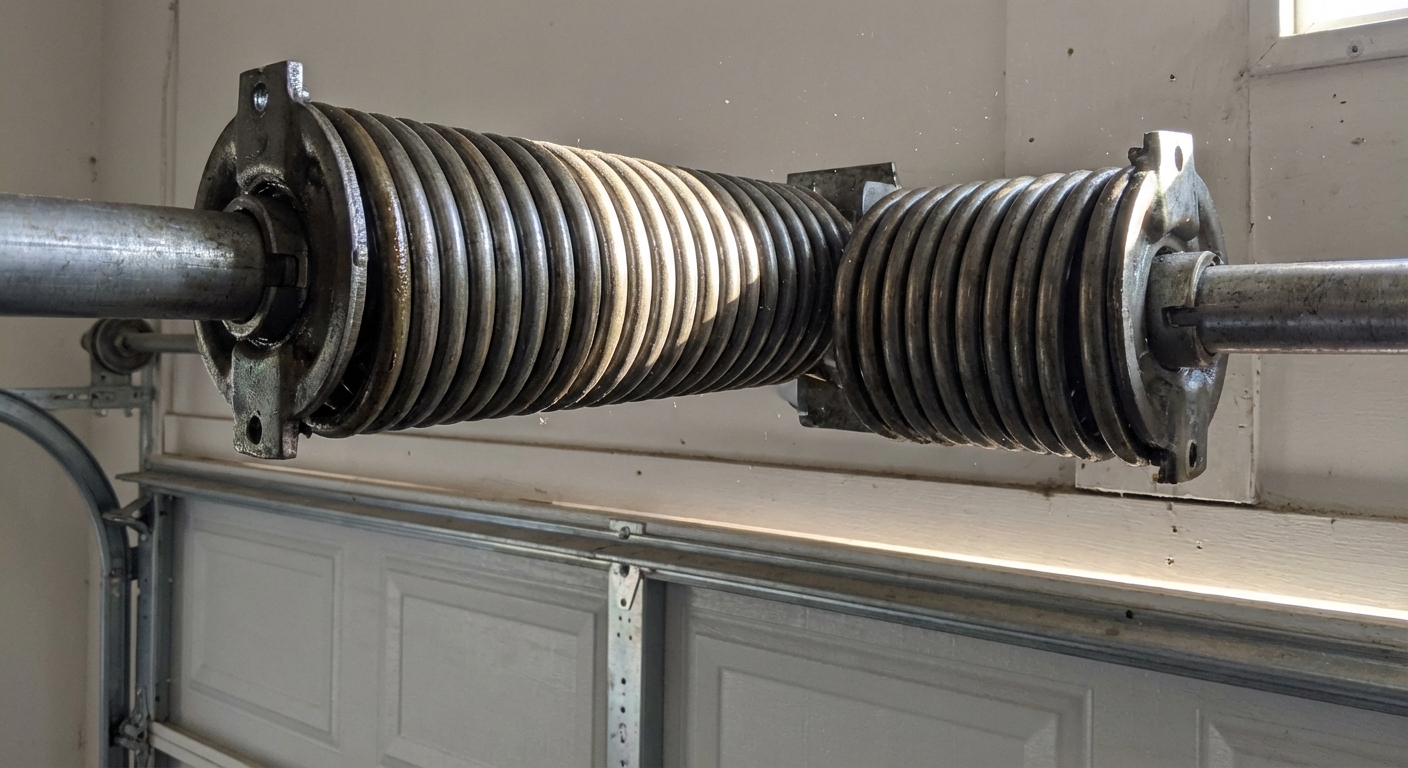
Before we can understand why springs break, we need to grasp the remarkable engineering behind how they work and the immense forces they manage every single day.
The Two Types of Spring Systems
Your garage door operates on one of two spring systems, each with distinct mechanical properties and safety profiles:
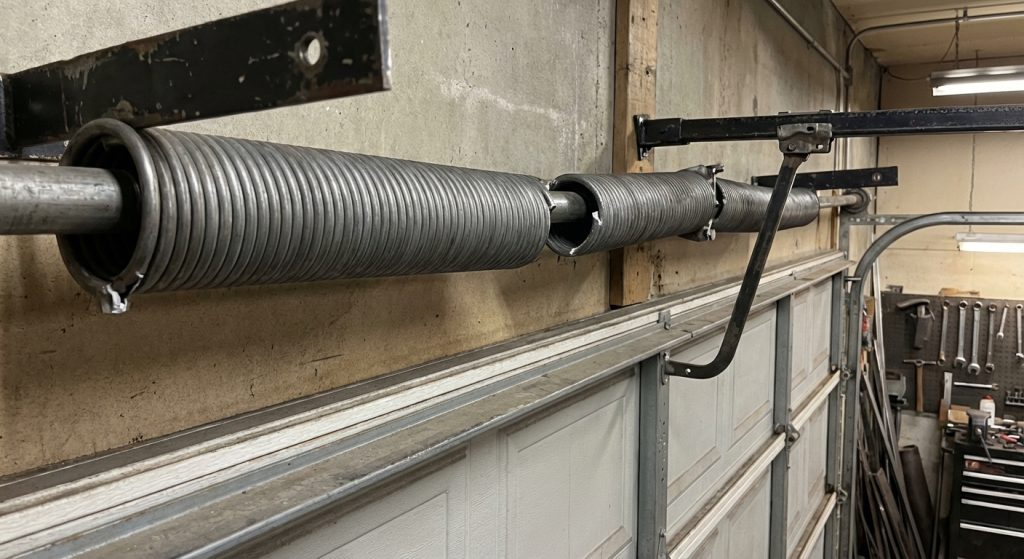
Torsion Springs are heavy-duty springs mounted on a horizontal metal shaft directly above your garage door opening. As the door closes, steel cables attached to the bottom corners force the springs to wind tightly around the shaft, storing rotational energy (called torque). When you open the door, these springs unwind in a controlled manner, releasing their stored energy to lift the door’s considerable weight. Because torsion springs remain attached to the shaft, they generally stay in place even when they break.
Extension Springs are installed parallel to the horizontal tracks on either side of your door. Unlike torsion springs that twist, extension springs work by stretching. As your door closes, these springs extend to store linear tension energy. The critical safety concern with extension springs is that when they break under full tension, they can become dangerous projectiles—which is why modern building codes require safety cables running through the center of each spring.
Comparing Spring Systems: Safety and Performance
| Feature | Torsion Springs | Extension Springs |
|---|---|---|
| How They Work | Torque/Winding (Rotational Energy) | Tension/Stretching (Linear Energy) |
| Where They’re Located | Above the door on a horizontal shaft | Along horizontal tracks on the sides |
| Expected Lifespan | 10,000 to 20,000+ cycles | 7,000 to 10,000 cycles |
| Safety Profile | High (Remains on shaft if broken) | Low (Can become projectiles without safety cables) |
| Door Movement Quality | Excellent (Better balance, smoother operation) | Fair (Can cause jerky movements over time) |
The Incredible Force Behind Your Door
Here’s the critical point every homeowner needs to understand: A spring calibrated to lift a 300-pound door holds 300 pounds of instantaneous tension. Think of it as a coiled steel cobra, storing explosive energy that’s released in a controlled manner thousands of times over its lifespan.
This stored energy is precisely what makes spring failures so dangerous and why professional expertise is absolutely non-negotiable for repairs. When that tension releases unexpectedly or is mishandled during replacement, the results can be catastrophic.
Why Springs Fail: Cyclical Fatigue, Cold Weather, and the Silent Killer—Rust
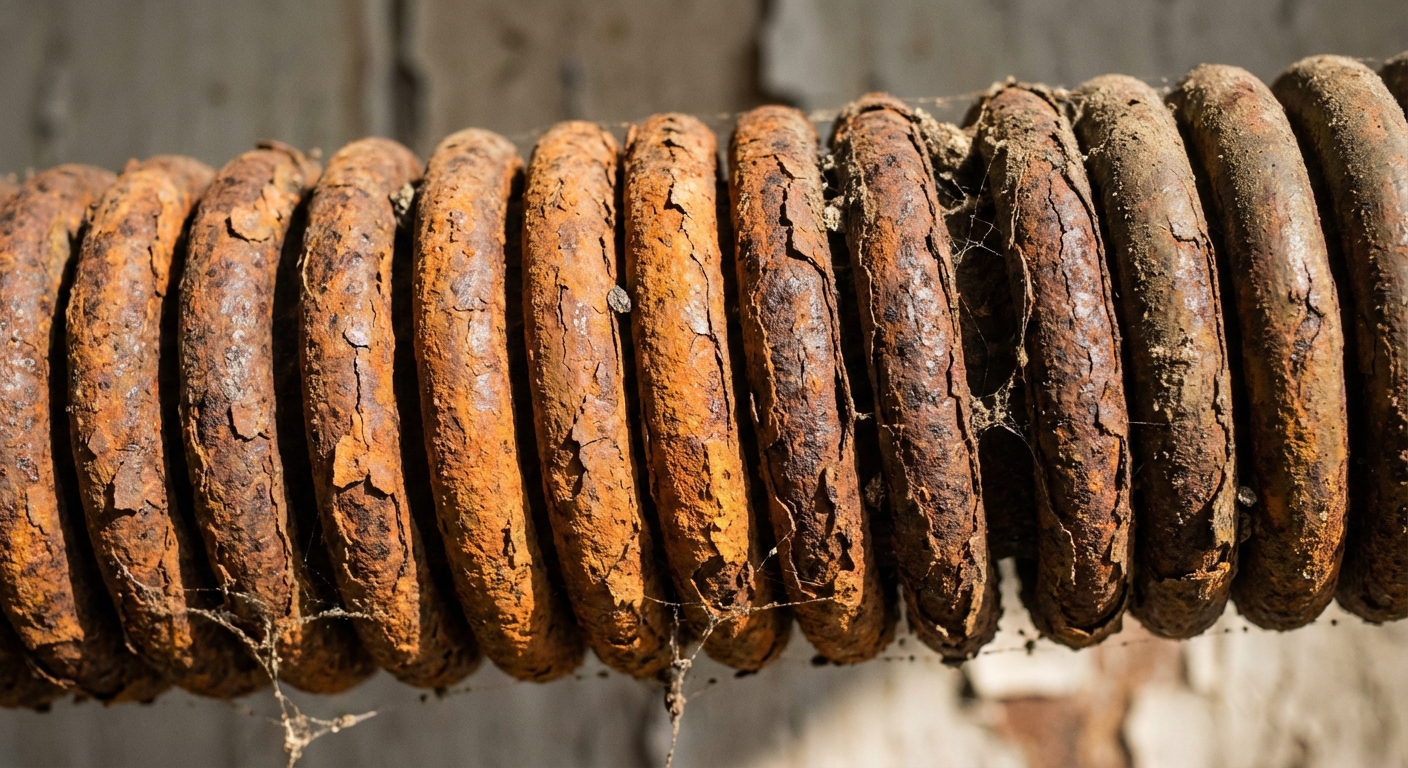
Garage door springs don’t fail randomly. Three primary mechanical and environmental factors account for nearly all spring breakages.
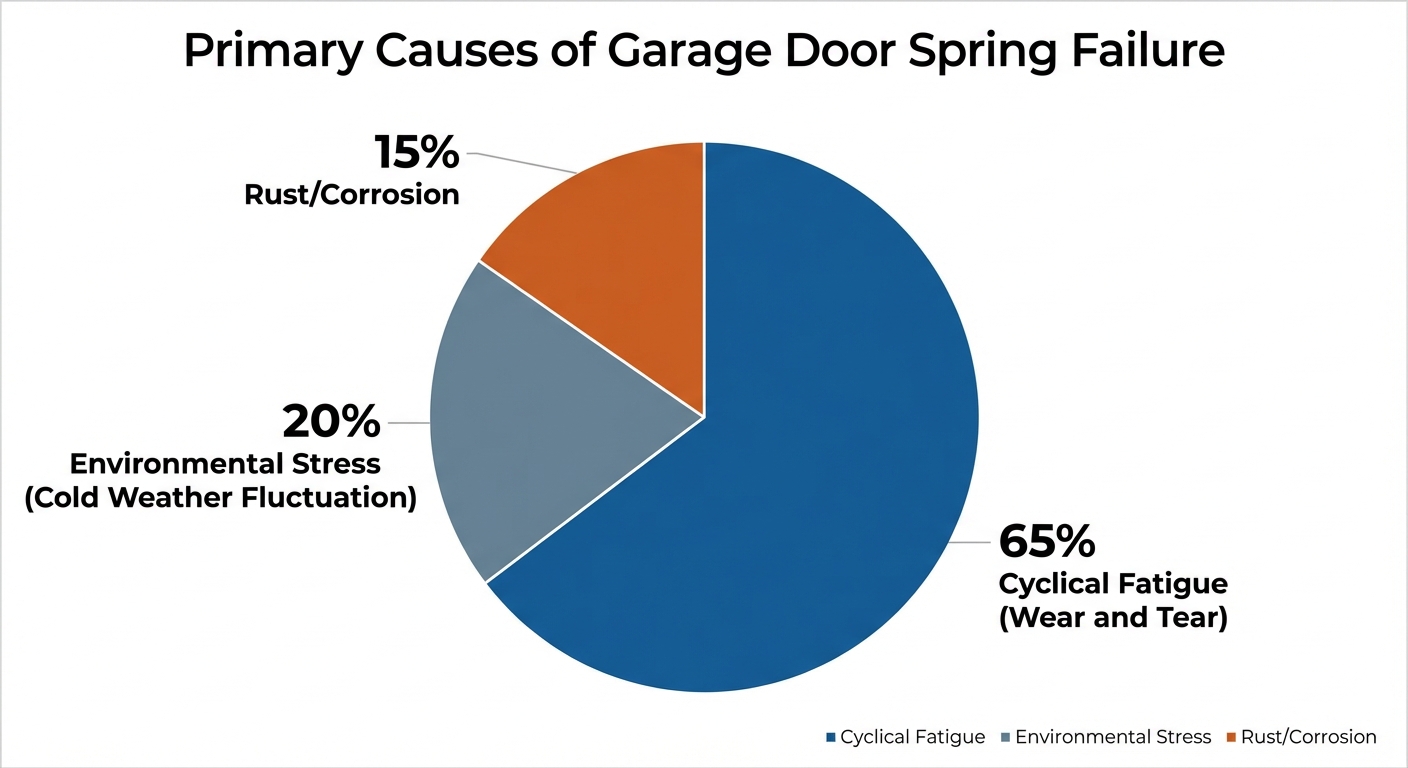
Cyclical Wear and Tear: The Engineered Lifespan
The most common reason your spring broke is simple: it reached the end of its engineered lifecycle. Garage door springs are rated by “cycles,” where one complete cycle equals opening and closing your door once. Industry-standard torsion springs are typically rated for 10,000 cycles.
But what does that mean in real-world terms? Your spring’s lifespan depends entirely on how often you use your garage door:
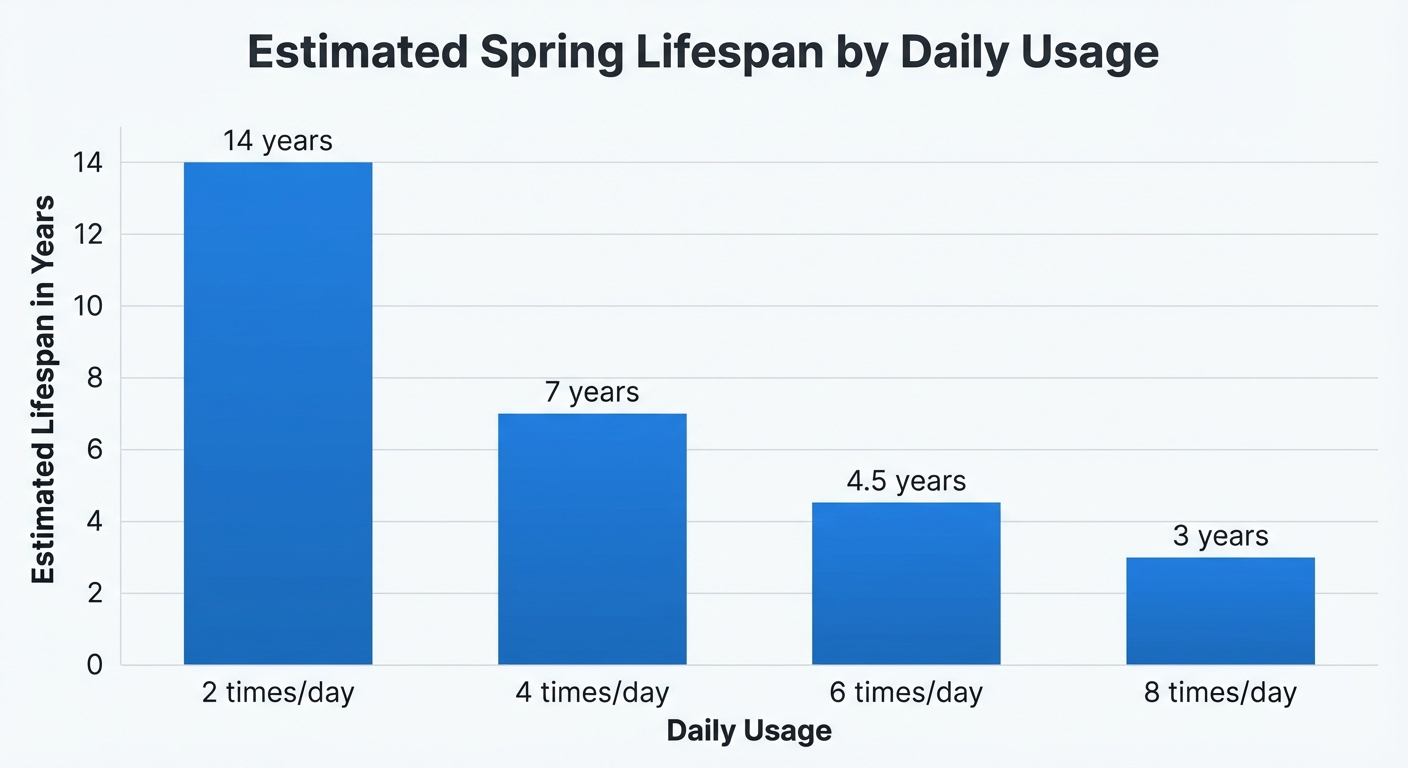
- 2 times per day: Approximately 14 years
- 4 times per day: Approximately 7 years
- 6 times per day: Approximately 4.5 years
- 8 times per day: Approximately 3 years
For families who use their garage as their primary entrance—especially during harsh weather—that 10,000-cycle spring might last only three years. Once the high-carbon steel reaches its fatigue limit, microscopic cracks propagate through the tightly wound wire coils. Eventually, the metal can no longer withstand the tension, resulting in a sudden, catastrophic snap that produces that distinctive gunshot-like sound.
Temperature Fluctuations: Why Springs Break in Winter
If you live in a cold climate, you’ve probably noticed that garage door springs seem to break more often during winter months. There’s solid science behind this pattern.
Cold temperatures cause the high-carbon steel in your springs to contract. This contraction increases the metal’s stiffness while simultaneously decreasing its ductility (the ability to flex without breaking). The result? Brittle metal under high structural tension—a recipe for failure.
The thermodynamic stress is even more pronounced if you operate your door immediately after a severe temperature drop. Opening your garage door on a sub-zero morning after it’s sat closed overnight puts maximum stress on already compromised metal. This explains why many homeowners discover their broken spring first thing on a frigid winter morning.
Rust and Corrosion: The Maintenance You’re Probably Skipping
Oxidation might seem like just a cosmetic issue, but rust introduces two destructive mechanisms that dramatically shorten your spring’s lifespan:
- Increased Friction: Rust roughens the smooth steel surfaces, creating friction between coils as they wind and unwind. This friction adds unnecessary mechanical stress with every cycle, accelerating wear.
- Structural Weakening: More critically, corrosion literally eats away at the steel wire. As the metal oxidizes, the wire’s diameter decreases, reducing its ability to hold the required tension. A spring designed to hold 300 pounds of force can no longer do its job safely once rust has compromised its structural integrity.
The Simple Fix: Applying lithium-based or silicone-based garage door lubricant every 3-6 months can dramatically extend your spring’s lifespan. This routine maintenance prevents rust formation and reduces friction between moving parts—a small investment that can add years to your spring system.
Why You Should Never Attempt to Replace a Garage Door Spring Yourself
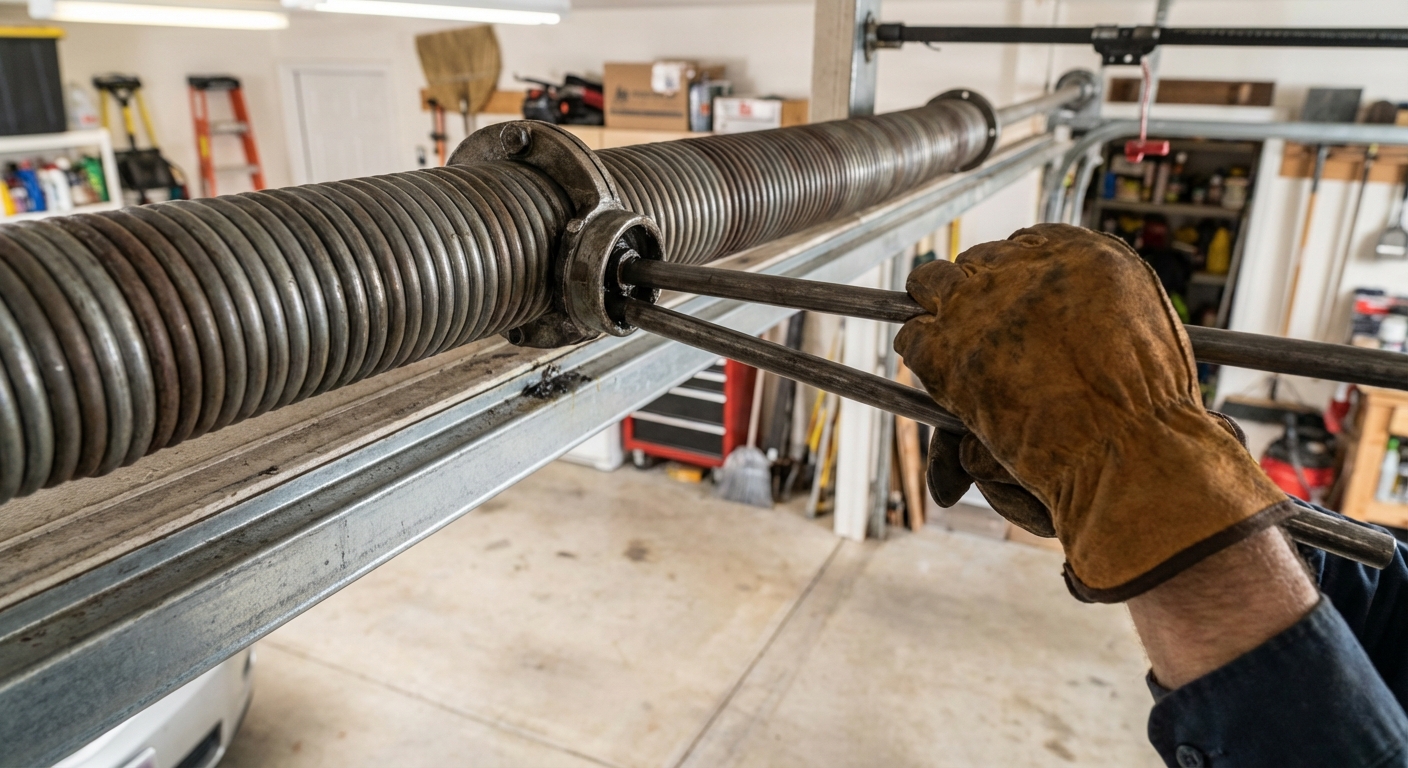
Let’s be absolutely clear: garage door spring replacement is one of the most dangerous home repair tasks you can attempt. This isn’t hyperbole or sales fearmongering—it’s backed by thousands of emergency room visits annually.
The Force Factor
Remember that 300 pounds of instantaneous force we discussed? When a spring is improperly handled during replacement, that energy releases violently and without warning. Winding bars—the specialized tools used to wind and unwind torsion springs—can kick back with bone-breaking force. Extension springs, when they snap under tension, become steel projectiles capable of piercing walls and shattering glass.
The Injury Statistics Are Sobering
According to the Consumer Product Safety Commission’s National Electronic Injury Surveillance System, thousands of garage door-related injuries are treated in emergency rooms every year. DIY spring repair attempts account for some of the most severe injuries, including:
- Deep lacerations and puncture wounds requiring surgical intervention
- Finger amputations from hands caught in snapping springs or cables
- Blunt force trauma to the face and head from winding bar kickbacks or flying extension springs
These aren’t rare freak accidents—they happen regularly to capable, handy homeowners who underestimated the danger.
Industry Safety Warnings
The Door & Access Systems Manufacturers Association explicitly states that spring replacement requires specialized tools and should only be performed by trained technicians. Professional technicians undergo extensive training and carry purpose-built equipment designed specifically for safely managing the extreme forces involved.
The most common DIY mistake? Using screwdrivers, pliers, or improperly sized winding bars as substitutes for professional tools. When these improvised tools slip—and they frequently do—the spring violently unwinds, turning your garage into a danger zone.
A Cautionary Tale
Consider this real-world case: A homeowner with an older extension spring system (without modern safety cables) experienced a spring break while lowering the door. The broken spring, still carrying its kinetic energy, shot across the garage like a javelin. It pierced through drywall and completely shattered the windshield of his parked vehicle.
This wasn’t the result of carelessness—it was simply the physics of stored energy releasing without proper containment. Modern safety cables prevent this exact scenario, but only if they’re properly installed by professionals who understand the system’s engineering.
Broken Spring? Follow These Critical Safety Steps Right Now
If you’re reading this because your spring just broke, stop everything and follow this protocol immediately. These steps will protect you from injury and prevent additional damage to your garage door opener system.
Step 1: Do NOT Attempt to Open the Door Manually
Your garage door with a broken spring has become “dead weight”—200 to 400 pounds of unbalanced mass. Without the spring’s counterbalancing force, attempting to lift the door manually can cause:
- Severe back injuries from the unexpected weight
- The door crashing down if you lose your grip
- Crushed fingers if the door slips while you’re adjusting your grip
Simply put: that door is not moving until a professional replaces the spring. Don’t try.
Step 2: Do NOT Use the Automatic Opener
Your opener’s motor is designed to work with the spring system, not replace it. The motor provides just enough force to overcome friction and inertia—not to lift the door’s entire weight.
Forcing the opener to operate without functioning springs will:
- Strip the opener’s internal plastic gears
- Burn out the motor from overload
- Snap the drive belt or chain from excessive tension
What started as a $200 spring repair can quickly become a $600+ combined spring and opener replacement. Don’t compound the problem.
Step 3: Leave the Emergency Release Cord Alone (If Door is Open)
If your spring broke while the door was in the raised position, that red emergency release cord dangling from your opener might seem like a solution. Do not pull it.
The emergency release disconnects the door from the opener track. With a broken spring, there’s nothing holding that heavy door up. Pulling the cord will send the door into freefall, crushing anything—or anyone—beneath it.
Step 4: Secure the Area
Take these immediate safety precautions:
- Disconnect power to the opener by unplugging it or flipping the dedicated circuit breaker
- Keep children and pets away from the garage until repairs are completed
- Do not park vehicles in front of a partially open door with a broken spring
Step 5: Call a Professional Immediately
Contact a certified repair service like Smart Doors LLC for rapid, professional spring replacement. Professional technicians arrive equipped with:
- The correct high-cycle replacement springs sized specifically for your door’s weight
- Specialized winding bars calibrated for safe tension adjustment
- Safety equipment and training to handle the dangerous forces involved
- Warranty-backed work that protects your investment
Don’t Risk Serious Injury
Smart Doors LLC offers same-day emergency spring replacement services throughout Southwest Washington. Our certified technicians safely handle the dangerous tension adjustments so you don’t have to.
Should You Upgrade to Heavy-Duty Springs? The ROI of Prevention
When your spring breaks, you have an important decision to make: replace it with another standard 10,000-cycle spring, or invest in an upgrade to heavy-duty, high-cycle springs rated for 25,000 to 50,000 cycles?
The High-Usage Scenario
If your family uses the garage door as the primary entrance to your home—especially common in areas with harsh weather—you’re likely operating that door 8-10 times per day. With standard springs, you’re facing spring replacement every 3 years.
That means:
- Repeated service calls and associated costs
- Inconvenient breakdowns, often at the worst possible times
- Continued exposure to the safety risks of spring failure
The Upgrade Solution
Consider this real-world example: A family of five was experiencing spring failures every three years due to heavy use. They upgraded from standard 10,000-cycle springs to heavy-duty 50,000-cycle springs. By increasing the wire gauge and spring length, the professional technician calibrated a system with an expected lifespan of over 15 years.
The Cost-Benefit Analysis
Let’s break down the numbers:
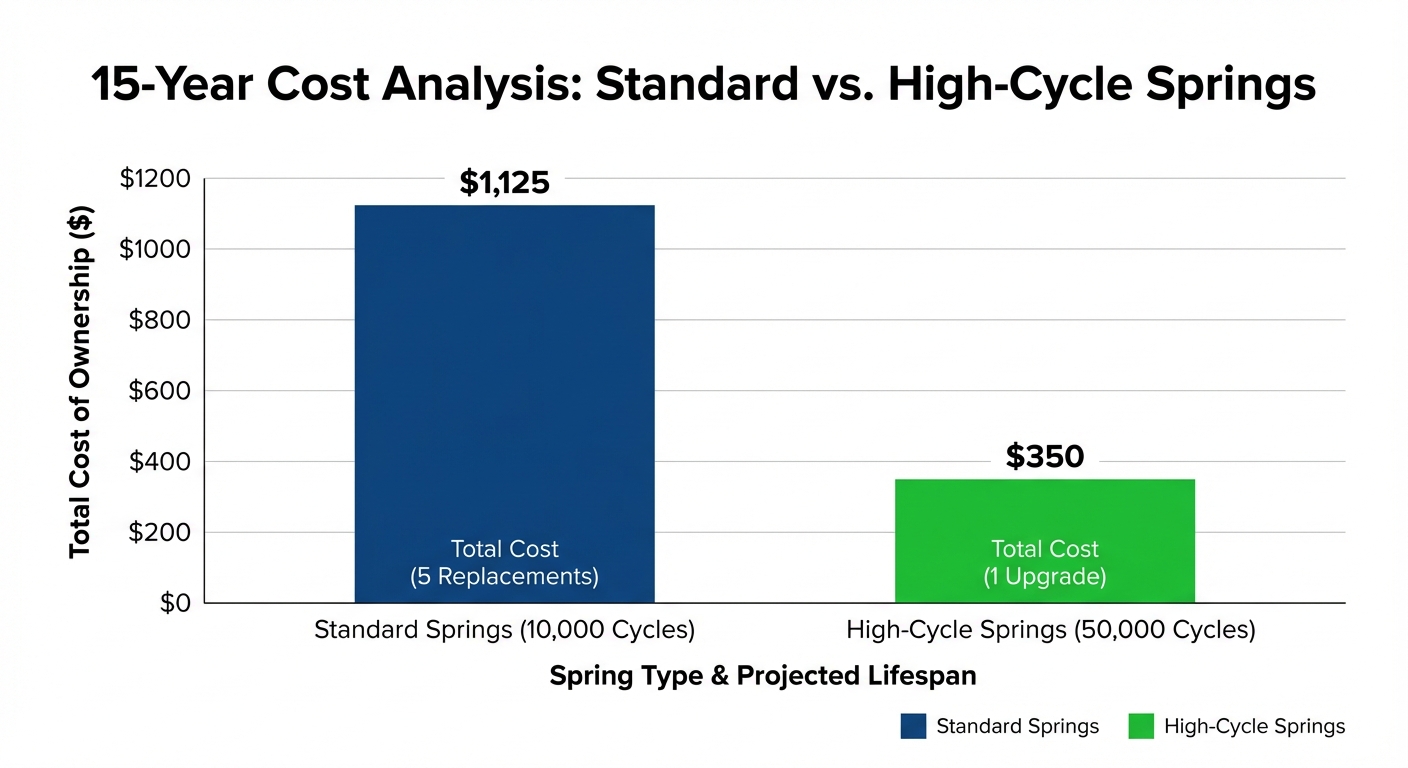
Standard Spring Path (15 years):
- Spring replacement every 3 years = 5 service calls
- Average cost per service: $200-$250
- Total 15-year cost: $1,000 – $1,250
High-Cycle Upgrade Path (15 years):
- Spring replacement at initial break: $300-$400 (upgrade cost)
- No additional replacements for 15+ years
- Total 15-year cost: $300-$400
Net Savings: $600-$850 over 15 years, plus the eliminated inconvenience of multiple breakdowns and service appointments.
Additional Benefits of Professional Upgrades
Beyond the obvious cost savings, upgrading to high-cycle springs during replacement provides:
- Better door balance, reducing wear on your opener, tracks, and rollers
- Smoother, quieter operation throughout the spring’s extended lifespan
- Significantly reduced risk of emergency failures during extreme weather
- Peace of mind knowing your spring system is built to last
Our Recommendation
For households with high garage door usage (6+ cycles per day) or homes in extreme climate regions (very cold winters or very hot summers), upgrading to heavy-duty springs during replacement is a smart preventive investment. The math is simple: spend a bit more once, or spend less multiple times over the next decade and a half.
When you contact Smart Doors LLC for spring replacement, ask our technicians about high-cycle spring options. We’ll assess your door’s weight, your usage patterns, and your local climate to recommend the most cost-effective long-term solution.
Key Takeaways
Garage door springs break for predictable, measurable reasons: cyclical fatigue from reaching their engineered cycle limit, thermal stress from temperature fluctuations that make steel brittle, and oxidative corrosion that structurally weakens the metal. Understanding your spring’s rated cycle lifespan and implementing basic preventive maintenance—particularly regular lubrication every 3-6 months—can maximize its service life.
But here’s what matters most: DIY spring replacement is extremely dangerous. The thousands of serious injuries treated in emergency rooms annually aren’t happening to careless people—they’re happening to capable homeowners who underestimated the explosive force of 300+ pounds of stored tension. Professional technicians have specialized tools, technical training, and experience specifically designed to handle these dangerous forces safely.
A broken garage door spring isn’t a home repair project—it’s a safety emergency requiring professional expertise. The specialized knowledge that certified technicians bring protects your family from catastrophic injury, protects your garage door opener from expensive secondary damage, and provides warranty-backed peace of mind.
If your garage door spring has broken, or if you’re hearing unusual grinding, squeaking, or popping noises that indicate impending failure, don’t wait for a dangerous emergency. Contact Smart Doors LLC today for a professional inspection and rapid repair. We offer same-day emergency service throughout Southwest Washington because we understand that your family’s safety and your home’s security can’t wait.
Your Family’s Safety Is Worth the Call
Schedule your spring replacement or safety inspection today.
References:
- InterNACHI (International Association of Certified Home Inspectors). (2023). Garage Doors and Openers Inspection. https://www.nachi.org/garage-doors.htm
- United States Consumer Product Safety Commission (CPSC). (2020). Non-Reversing Automatic Garage Door Openers Are a Hazard. https://www.cpsc.gov/s3fs-public/523.pdf
- DASMA (Door & Access Systems Manufacturers Association International). (2022). TDS 161: General Information Regarding Garage Door Springs. https://www.dasma.com/dasma-technical-data-sheets/
- ASM International – The Materials Information Society. (2019). Fatigue and Fracture of High-Carbon Steel. https://www.asminternational.org/
- CPSC National Electronic Injury Surveillance System (NEISS). (2023). Injury Estimates Pertaining to Garage Doors and Hardware. https://www.cpsc.gov/Research–Statistics/NEISS-Injury-Data
- Institute of Door Dealer Education and Accreditation (IDEA). (2023). The Value of Professional Installation and High-Cycle Hardware. https://dooreducation.com/